Feeds:
Posts
Comments

Archive for the ‘Goat Care (and General Farm)’ Category

Akira (2008)

You know the story, about the time you think everything has happened that possibly can, you are reminded that it hasn’t.

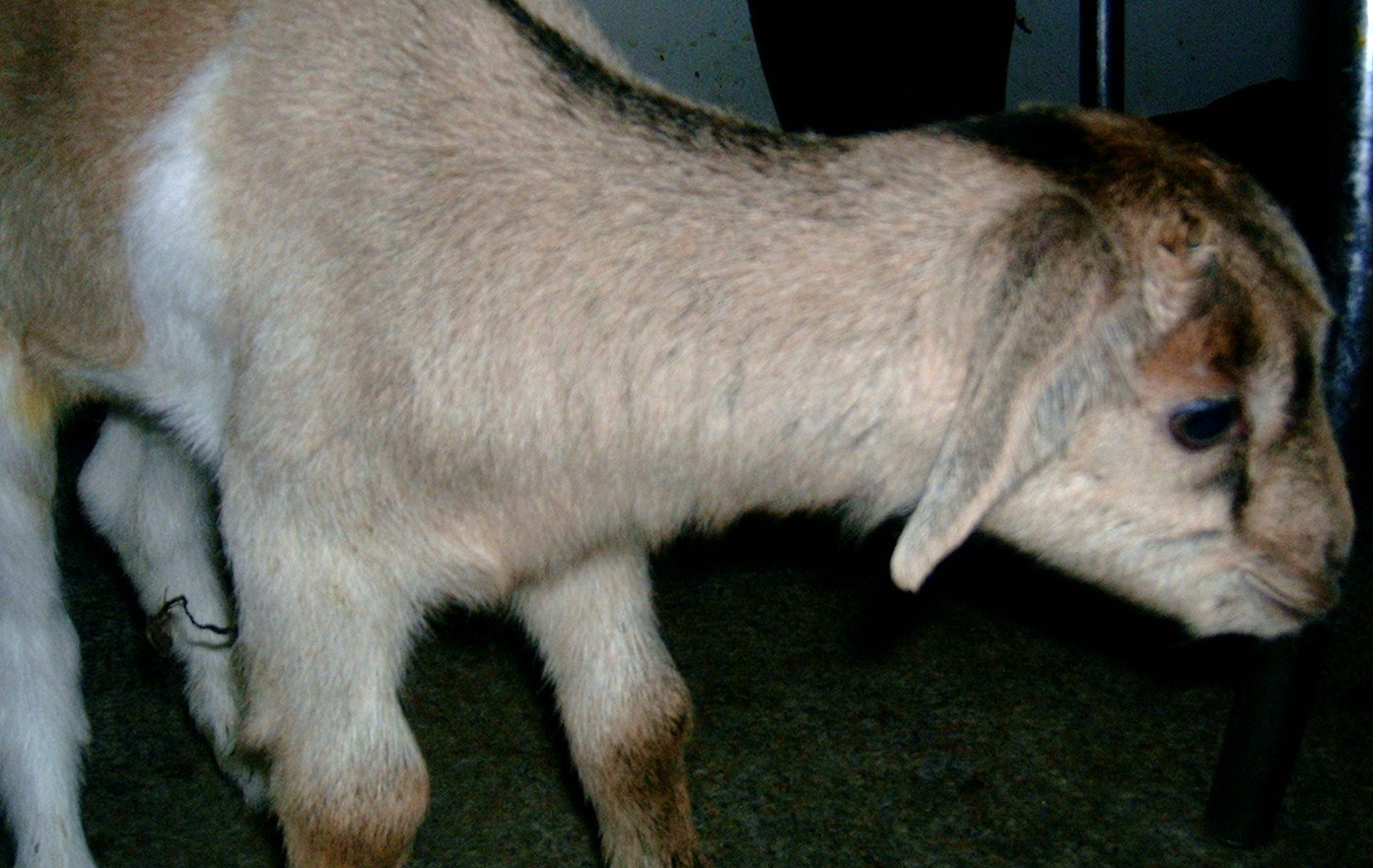
A little background on one of the does:  Akira is an alpine/nubian born in 2008.  She has a coat that is slightly longer than most of the goats in the barn.  She is a stocky type of girl.  She does not fit into the graceful lines of a dairy doe. 

When I walked into the barn to feed a few days ago I immediately set eyes on a newborn.  She had a clean dry coat.  She was walking around like she knew the world already.  Then I began the task of finding the mother.  Akira! How in the world did she have a kid? I checked her udder, I didn’t feel one.  She had not looked pregnant. 

Because I did not feel an udder, knowing there was no milk, I knew I needed to get colostrum in the kid very soon.  So, to the freezer I went for a bottle.  I returned with a warm bottle and the struggle began.  The newborn was angry.  She refused to eat.  Akira was not hovering. 

So, I deposited the newborn in a pen with bottle kids and returned in a couple of hours.  Still, she refused to nurse. 

I knew it was going to be a long night.  And I was tired.

I picked up the little doeling, marched to the house with her for the night.  I can sleep-walk and feed a newborn fairly well. 

She  finally ate at 4:30 AM the following morning.

When we returned to the barn later that morning I immediately felt Akira’s udder.  She had milk, a lot of it.  

I set the kid in an empty stall and took Akira to the milk stand for the first time.  I milked out about a tablespoon of colostrum and dabbed it on the newborn’s lips and under her tail.  I wanted the newborn to be recognized by sight and smell.  When I took Akira to the pen, there was no sniffing involved.  The reunion was spectacular.  And guess what? The kid definitely knew what an udder was.  She had been there before.  She lunged for it, even though her belly was already full.

Akira’s udder is rather high.  She is milking out beautifully for me.  She had milk all along. 

All is well.  Just call me the goat kid snatcher.  And, without a doubt, Akira hovers now.

Have a good day!

Read Full Post »

If you are a regular reader of the Annie’s Goat Hill blog, you likely have heard me mention water problems.

Our well runs low.  It runs slow.  It runs mucky from time to time.

About a month ago I realized how my life has circled around the effort to conserve on water.

I set the timer on the washing machine for the middle of the night.  I wash dishes first thing in the morning.  Water for the animals comes first.  Everything else comes last, and I do mean everything.

The equipment is now in place.  They will be drilling for a new well within a few days. 

We have been told that this area is hit or miss for water.  I am going to think positive. 

This week has been a flurry of water shortages, and bad water problems that have affected faucets, the washing machine, pipes, you name it.  It does not affect my products because when water is required I use distilled water, thankfully.  What it does affect, however, is soapmaking.  When you cannot wash your equipment, you do not make soap.  That seldom occurs, but it has knocked at the door this week!

I’ll tell you a little “funny” that I will likely never forget.  We helped a friend who lives a mile away with a room addition a few summers ago.  They developed a large leak in their hose.  It sprayed up in the air like a large fountain.  It stayed that way the entire 2 weeks we assisted at their farm.  They never shut it off.  I was amazed that someone would have that much water, within such a close range of this area.  The image is forever stuck in my mind! Thou shalt not envy, right? Well, I envied!

Have a beautiful day!

Read Full Post »

Until today, I had forgotten how grown bottle kids still root for a bottle. 

Today I made some changes.  I moved the last kids, a set of triplets, to the barn.  Then I arranged pens so all of the bottle kids would be in one place at night. 

After feeding and milking, my well-oiled plan began to fall through the cracks. 

I sat down on a bucket to feed the bottle kids and along came Sarah.

Sarah is a grown boer goat (black headed) who was raised on a bottle 3 years ago.  She is now a good mother.  Sarah tried everything to get the bottle away from a kid I was feeding, including biting his ear.

Along came Amelie, a special case kid, who was on a bottle 2 years ago.  As I bottle fed one kid, Amelie was right against my cheek with her nose, breathing hot air, blocking my view totally.  I do love to feel a goat’s breath.  It is pure life.  Occasionally I wish I could pick and choose when I received the delights.  Funny, huh?

Then along came Chameaqua.  She recently gave birth for the 2nd time.  She apparently hasn’t forgotten the bottle either.  She ripped and tore through my nicely laid out supplies just to find a bottle for herself. 

Are you laughing with me? I am.

I love animals too much.  I will admit to it.  It is terribly hard work.  But, I still love it.

Read Full Post »

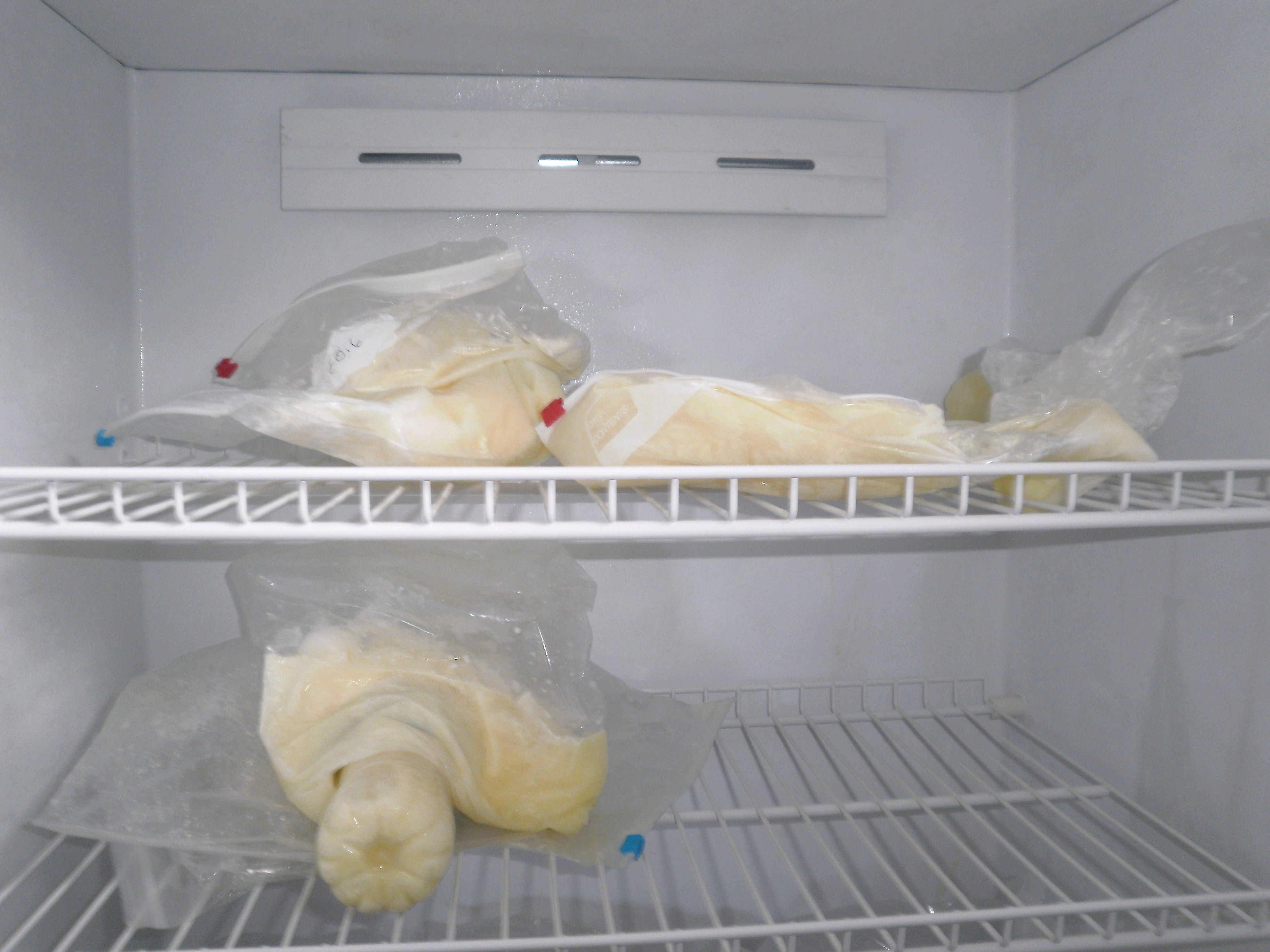
Yep, the freezers are emptying quickly.

The photo above shows the two top shelves of the commercial freezer in my shop.  We also have a freezer in our laundry room, one in the barn, and one 1/2 full at a friend’s house.  All are empty except for the freezer at the friend’s house. 

One small goat kid can consume 4-20 ounces bottles of milk a day.  Multiply 80 ounces a day by 10 kids (give or take) and the freezer doesn’t stay full long!

Remember the goat milk transportation going on a year or so ago (here)? There will be no need for it this season. 

Cleaning the freezers will now be a breeze…that is a plus!

Milk replacer is now being introduced at a ration of  1/2 milk replacer/water, 1/2 milk.

And there is still enough fresh milk for soap and lotion, barely. 

The kids are certainly a lot of fun.  They are a lot of work.  And I do enjoy them while they are little.  They do not stay that way long.  They are a blessing.

You might ask, why bottle kids? Sometimes unplanned things happen.  I had a lot of triplets this year, for starters, the third in a set just do not get fed well, and sometimes the third is a weaker kid.  Other factors were involved as well.  Just call me the Goat Milk Bottle Queen.  It seems to be my job each spring.

Have a beautiful day!

Read Full Post »

The dairy does are gradually returning to “in milk” status, meaning they have “freshened” (given birth) and are producing milk once again.

As I mentioned here, I am doing a trial run this year. I am leaving the kids on their dams and milking them as well. It has been interesting so far.

First, I am dealing with 3 new milkers. I did not prepare them for the . They simply have not been handled much, not like their mothers were. My back and legs are paying for it. But, the girls are slowly realizing that their stepping up to the milk stand results in a nice portion of grain.

Normally my milking process is smooth as silk: check the udder health, clean the teats, put the inflations on, and then stand back as the doe is milked out by the machine (being careful to not totally strip every drop out, mastitis prevention). With the new arrangement my first step is to bounce and feel the udder to determine which side(s) the kids are nursing on. Then I carefully milk out the other side. Basically, I even the udder up. I do not want to steal nourishment from kids. At the same time, if I do not milk properly, not enough, nature and hormones will take over, and a pattern of less milk produced will be set for the remainder of the does current milking season. These are some of my recent challenges. There are others that will become additional blog posts.

I have 8 girls in milk now, with possibly 6 more to go (3 of which are also new). My work is cut out for me. I am tired, slightly overwhelmed from time to time, but as my husband said (regarding both the goat and soap business), “You are doing what you asked for. You are feeling growth pains.” And this will pass.

Read Full Post »

I do not tell many kidding stories.  A person tends to get used to the births, despite the fact that they are quite miraculous.

Iris had kids a couple of days ago.  It was a “different” experience. 

Iris is an average sized alpine doe.  She normally needs a bit of assistance.  I seldom need to help any of my other does.   I prefer letting nature do its thing.

The story unfolds as such…Sunday morning Iris was standing off to herself.  She is a bit more vocal when labor is in progress. 

I was concerned to see the remnants of a water sack hanging from her.  The order of things was not what I normally see.  In fact, I looked around for a dead kid.  I decided to put Iris in a small stall, with the notion that I would check on her every 20 minutes.   I headed up to the house.

A few minutes after I entered the back door I heard Iris grunting.  I also heard another grunt that was not hers.

I headed back down to the barn.  Snowball, a snubian, first time freshener, was in labor.  She picked a precarious place to have a kid, in a doorway.  Half of my herd was looking at me as to say, “Traffic jam!” I urged Snowball towards the middle of the barn, which was readied with clean straw bedding.

I turned to check on Iris, sounding more desperate.  I saw one hoof.  Just one.  Ugh.  Not good.

Snowball started grunting loudly.  One hoof, then 2nd hoof.  She screamed louder.  My goats normally do not scream, and normally I do not need to assist. 

I took another glance at Iris.  Still one hoof. 

Snowball began pushing again.  I looked at the hooves, made sure they were pointing in the right direction.  They didn’t look right.  I went in.  Felt one head.  It was positioned correctly.  I decided to pull.  It was a job.  Wow.  But we did it.  Mother and new buckling (male goat) are fine. 

I checked on Iris, talking to her, “I will not do anything until I see 2 hooves.”  Something seemed off.  Even the color of the discharge.  Dark yellow. 

Iris began pushing again, no progress.  So, I checked.  I felt a head in the right position, and said, “Okay, girl, when you push, I will pull!” Wow, another struggle, but we got that beautiful doeling (young female goat) out.

I knew Iris was not finished.  I said to her, “Well, momma, your next one will be fairly simple.”  I’ll stand back and wait.   I left the pen open.

It was not long before Iris laid down and grunted.  No hoof.  Not even one.  Then I see a tongue.  A nose.  No hoof.

I was tired, so was she.  I am tired a lot lately.  It tends to make me very careful and aware with judgement calls.

I went in, beyond the kid’s neck.  Shoulders only, legs back.  Oh oh.  Another push.  Out comes an ear.

I cleared the nose and the mouth.  The kid took a breath. 

And for whatever reason, Iris shoot out of the pen and ran to the back of the barn.  A very dirty end of the barn.

The kid’s eyes are open, the head was completely out, and Iris was going at a good trot.  Well, she doesn’t run well when her udder is that swollen, and especially while in labor. 

And…I was laughing.  I said to her, as I calmly walked behind her, “You are one crazy goat chick!”

I told her she was not going to have a kid in that dirt!

So I let her lay down.  I gently urged the kids head forward (not a good thing to put much pressure on).  I did get a tiny bit of forward movement.  I went in and found a leg folded back.  Finally, leverage! It wasn’t a difficult pull, I got the 2nd doeling out and I laid her on momma’s side. 

I’ll never forget goofy Iris flying down the barn.  Her legs were spraying outwards.  The kid’s eyes were open.  She was going for a ride! What a way to start a new life.

I shake my head and giggle.

The things we see and do.

Praise the Lord I get to experience these beautiful things.

Life is a miracle.

Read Full Post »

Goat Coat

The Caped Crusader

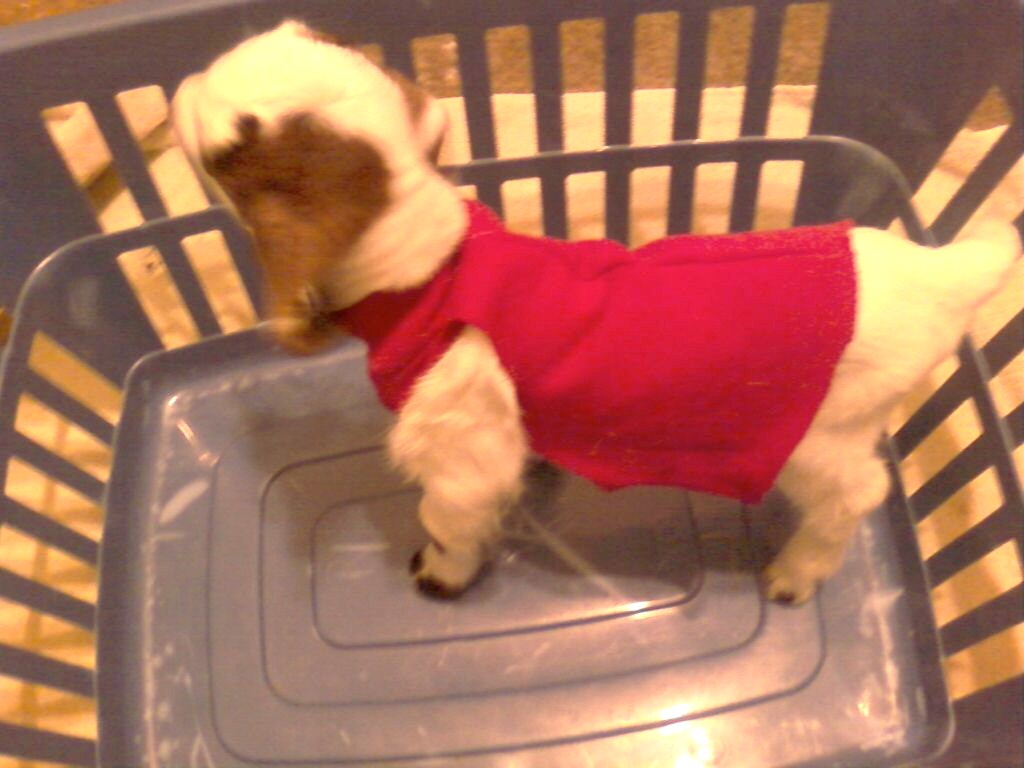
I apologize for the poor quality of the pic.  My phone was the only camera available at the moment.  And goat kids most certainly do not stay still long, hence the clothes basket!

This little tyke is nic-named The Caped Crusader.  He was born from a set of triplets.  At birth he weighed in at just barely 2 pounds.  A newborn boer goat buckling (young male goat) normally enters the world between 7 and 9 pounds. 

The Caped Crusader’s life was touch and go for a day or so.  I am able to say he is now happy and gaining activity as each day passes.

He won the Annie’s Goat Hill honors of wearing a goat coat. 

I cut goat coats from sleeves of women’s sweatshirts.  The wrist bands are perfect for a small goat’s neck.  The coat is slit down the middle, and slits are cut from the sides to make “arm holes.”  They are great for the tiniest of kids that chill easily.

If you do make a goat (or lamb) coat, make sure the animal can breathe well, and that they cannot snag themselves in anything dangerous by the fabric.  If the neck is too taught, stretch it with your hands before you put it on the kid. 

The coats are washable.  They do not fray around the edges.  Wash and dry.  Simple.

I would imagine these coats would also work well for a small dog.  Or a larger one if you used a man-sized sweatshirt.

Do you like it?

Our Cape Crusader does!

Read Full Post »

Reviving Chilled Newborn Goat

I have a method for reviving a very chilled newborn goat (kid).

Sharing of my method is not intended to replace veterinary advice.

Planning the breeding of a goat to ensure kidding occurs during warmer weather is optimal, but sometimes the best laid plans do not fall into place.   A dam may become confused with twins, triplets, or she simply may lose interest (or never gain it with a newborn).  What that being said, there is a necessity for knowing how to revive a very chilled newborn goat kid.

Facts first:

  • Normal goat temperature is 102-104
  • A newborn kid will not retain its own body heat until it has nutrition in its digestive system (colostrum)
  • A newborn goat kid must receive sufficient colostrum within the first 4 hours of their life (to retain body heat, get their digestive system working, immunities built, and to protect from health problems that can occur within their first few days or weeks)
  • A very chilled goat kid cannot, and will not, nurse.  Do not attempt to drip liquids down their throat.  If they are very chilled, to the point they cannot nurse, the liquids will more than likely reach their lungs and drowning can occur, or pneumonia will set in very rapidly.

A thermometer is the best method for taking a goat’s temperature, however, inserting your finger in a newborn’s mouth, touching the back of their tongue area, is a very good indicator of the kid’s temperature.

When a chilled newborn kid is found, depending upon how cold they are, how wet they are, and if they have had any colostrum, they may exhibit signs of near-death such as extreme legarthy, slow respiration, drawing of the head to the left, or a weak heartbeat.  In all of these cases, run, don’t walk, to begin reviving the kid.  Minutes are left in the newborn’s life!

My method:

  • Place the kid in a sink of water (as close to normal goat body temperature as possible).  Keep the newborn’s nose and mouth out of the water.  Maintain the water as close to temperature as possible.  If the kid is very chilled you may find the water cools down quickly.
  • Maple, corn syrup, or molasses.  I keep a bottle of maple or corn syrup in a cabinet next to the sink.  As I hold the kid in the water, I pour a couple of teaspoons of syrup into a small bowl.  I dip my finger into the syrup and rub a small amount into the kid’s cheeks.  Repeat several times.
  • As the kid’s body temperature nears a safe level they will begin to jerk or shiver.  Until the kid begins to do either, their body temperature is probably not climbing.
  • Once the kid is more alert (temperature nearer to normal) I pull them from the warm water, quickly wrap them in a dry towel, and begin drying their coat with a hand held hair dryer.  Caution, light massage is a good thing, but never be overly rough with towel rubbing, etc…, kids can only take so much when they are already exhausted.  When drying the coat, to avoid burning the skin, do not hold the dryer too close, or in one position.  Use sweeping movements.  I try to gently massage with one hand, while holder the dryer with another.
  • Once the kid is dry their body temperature has probably increased greatly.  They should be more alert, but will likely still be showing signs of impending death.  At this point I administer liquids through injection.  Using a 20 gauge needle, 1/2″, I begin injecting Dextrose (use the 5% solution, and/or the Dextrose solution manufactured specifically for injections), SQ (under their skin), in the area between the shoulder blades.  Pinch the skin to form a “tent” and inject just under the skin.  The kid can survive off of the SC liquid for several hours.  I normally inject 3 ML Dextrose, repeat, until a “hump” has raised between the shoulder blades.  Within 15-20 minutes you will notice the hump going down.  This means the body is absorbing the liquid, a very good thing.  If the kid has not revived fully, revive this process as new fluids are needed.  The kid’s body will absorb all of the liquids it needs via the injected liquids.  I also keep Lactated Ringers on hand (a bag of saline IV solution purchased from the vet).  In extreme cases, I will rotate my injections between Dextrose and Lactated Ringers.  Keep the kid wrapped in a dry towel, and make sure they are in a warm location.
  • Again, do not try to force liquids down the kid.  They will develop pneumonia, and they cannot nurse (or swallow properly) until their body functions resume to a normal level.  Once the kid is hydrated and their body temperature is normal they genrally want to nurse.

Revival of a chilled kid is a gradual process.  Do not expect results in 5 minutes.

Once you have had to do the process several times, you begin to notice the heartbeat (just by touch), respiration (by watching the nose and chest), and how the kid looks in the eyes as you go through the revival process.  Goats have what looks like an angry, not bright, look to their eyes when they are not well.

One last note, always keep frozen colostrum on hand.  You never know when you will need it this type of emergency.

If you need help with anything I have said here, please let me know!

Do not forget to talk to the kid as you work with them.  They respond to voice.  Goats give up easily when they do not feel well…your voice may just be enough reassurance to help them cross the bridge to a healthy long life!

Read Full Post »

The melting of the 20+ inches of accumulated snow has begun.

I could see a blue tinge to the early morning sky at 6:30 A.M., I knew sunshine was to follow.  It did.

Now the beautiful bright sun is gone.  It sure was pretty and uplifting while it lasted.

Now that the thaw has begun the icicles are growing like crazy.  We are going to have to knock some of them down.  Problem is, this old house has some dangerous areas.  When snow and ice melts, everything tends to run down the roof to the old concrete patio (where I took the photo), and down the sloped yard.  This old house, I lovingly refer to, has had several additions, several with different roof angles.  Every piece of ground goes downhill except for a small patch of driveway next to the house.  I think we need guardrails!

Melt, freeze, and melt again.  Repeat.

I had a handful of goat kids born during the snow storms.  Some are in the barn.  Some are in the house.  Two that were born during one of the coldest mornings, two out of a set of triplets, were near death.

My newborn kid revivial system will be posted in the next blog post.   It might help someone in the future with a very chilled newborn goat kid.

Other than loads of snow, ice, and newborn goat kids, there isn’t a lot of new news.  I have been busy.  Which is nothing new.  As I said once before, it will not be long before I will seek help. 

I represent the simple life.   I also need to ensure I keep it as simple as possible, or I’ll be boggled to the point nothing functions correctly.  Then what good would that do for Annie’s Goat Hill?

How are you doing this winter? Thawing out? Ready for the spring garden?

Read Full Post »

Snubian Goat

Chameaqua - Snubian Doe

This season I am experimenting with management of the dairy goat kids.

In the dairy world (cow, sheep and goat) the herd keeper either bottle raises their dairy kids, or they allow the kids to be raised by their dams.

I normally bottle raise my dairy kids. 

Bottle raising kids is a huge undertaking, especially in cold weather.  One year, during a blizzard, we had 19 kid goats in the house at once.  We had dog crates everywhere.  Sleeping, eating, bathing, all of the normal human functions in the house were difficult.  The washer and dryer ran constantly.

Why did I do it? I wanted to protect the dam’s udders.  I wanted the udders symmetrical (goat udders have 2 compartments), and I did not want their udders to suffer any injury from the kids.  Goat kids really “knock” hard on their dam’s udder when they are nursing.  Knocking on the udder helps to release more milk.  The releasing, or dropping, of milk is entirely hormone/mental/physical. 

This year I decided to allow the first dairy doe that freshened (to give birth) to raise her kids.  So far it is working well. 

Chameaqua (a snubian doe, one of my own past kids) gave birth to two doelings.  She took to motherhood like a champ.  She came back to the milk-stand like a champ as well.  I do not excessively milk her out.  I basically even up her udder, releasing any pressure.  Like a God-send, her twins are pretty much nursing from one side of her udder.

I have been able to put precious colostrum back in the freezer, which is always a necessity for a goat person to have on hand. 

Note:  I ensure a kid has colostrum in their belly within the first 4 hours of birth.  A kid’s first drink of colostrum affects their health for the rest of their lives.  And, a goat kid cannot maintain their own body heat without fuel in their belly. 

With Chameaqua passing the dam-raised test, I will be allowing all of the dairy girls to raise their kids.

No more heartache for me.  It was not easy to remove their kids.  Plus, I will still put milk in the freezer (for soap or kids) and/or have fresh milk on hand for lotion.

Everything will work out perfectly!

Read Full Post »

« Newer Posts - Older Posts »

Design a site like this with WordPress.com
Get started