Feeds:
Posts
Comments

Archive for the ‘Goat Care (and General Farm)’ Category

We are changing our website, switching to a storefront.  Sreamlining for 2012.  Our thinking is why have both a blog and a website? There’s a lot of writing and reading going on, with current product information here, at our blog.

Over the next several weeks I am going to copy photos from our current website over to our blog, to ensure what people enjoy now on the website, will still be available (via the blog).

At the same time, I am going to throw in some of Annie’s Goat Hill original photos.  I hope you enjoy looking back and seeing some “faces” and stories you haven’t seen in a while.

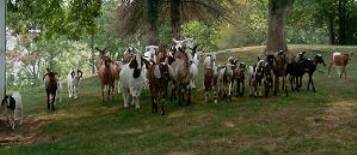
In this photo, to the left is a doe that we currently own that is wild, but one great mother.  The middle doe is Sarah, one of our favorite grown up gals.  She is vocal.  Always “maaa’s” up to us at the house when she sees us outdoors.

Love you all! Enjoy!

Annie’s Goat Hill Handcrafted Soaps – Smell and Feed the Goodness!

Do not be conformed to this world, but be transformed by the renewal of your mind, that by testing you may discern what is the will of God, what is good and acceptable and perfect.         Romans 12:2

Read Full Post »

Hilarious nuts they are, food driven animals…I get so much enjoyment from  watching their antics!


Shared video from the Goats In the Garden blog.  Thank you Jennifer!

Annies Goat Hill Handcrafted Soaps – Smell and Feel the Goodness

Read Full Post »

Sometimes we need a course on goat psychology…but then, if we understand them tomorrow, we might not understand them the next day.

We moved a handful of goats to the new farm, ahead of the others.

We did not mow the tall grass in their new pasture.  We also knew the cedars and the tree saplings would be a nutrition-filled delicacy for the goats as well.

We chose the thinnest, oldest, and most “needy” of our “girls” for the first move.  I wanted them to experience the fresh new pasture.

Surprise!

We should have known.  No, in fact, we did know but never thought it would happen to our goats.  They did not touch the greenery for the first 3 days.  Each day when we arrived to feed hay, yes, we still supplement (in a lesser quantity), we observed the does getting thinner.

Our determination is that they were 1) stressed because we moved them, 2) spoiled to their old barn and twice-a-day hay feedings.  Of course, they had no idea we moved them from an almost bare lot to something totally alive and healthy!

The good news is they are now eating.

Lesson learned, and shared.  It really is best to not move an overly thin goat, or one that isn’t feeling well to begin with (our goats were not that serious).  Even if you are moving them to better conditions, they are sensitive animals and could become ill from stress alone.

All are happy now!

Annie’s Goat Hill Handcrafted Soaps – Smell and Feed the Goodness

Read Full Post »

Goats cannot fend for themselves when they are tethered (collared and tied) to a fence post or tree.

Goats are prey to wild animals, such as coyotes.

If you must tether a goat, only do so when a livestock guard animal is present, and only tether for short periods of time, making sure the goat is supervised.

Always provide shelter and fresh water.  Goats easily “go down” with pneumonia and other diseases when they are exposed to wet and cold conditions with no means to get out of the weather.  Stress is very difficult on goats.

Goats are wonderful weed-eaters, they truly clean up grassy and weed infested areas with gusto…but please, please, please, protect their lives.  Their only defense to prey is to head butt and run.

Please pass the word along – tether responsibly (or not at all).

Read Full Post »

Each season the decision is made when to stop milking the goats.  My business depends upon fresh goat milk, a very obvious fact.

I could purchase milk at the grocery, or in cans, or in the powdered form.  But our products contain our milk, produced from our goats, milked by me.  That is who we are! I know what goes into the goat’s mouth, therefore, I know what does not end up in the milk.  Nothing else will do.

So, to give the “girls” (does) that are “in milk” (currently being milked) a break before they “freshen” (give birth), I make the seasonal decision to remove them from the milk stand.  The decision involves looking at the calendar and the freezer contents for a count, and sometimes even a second look.  I will admit, there are moments that some would consider nail-biting.  Cutting the cord to fresh milk, take a deep breath!

Happily, both freezers are spilling over with frozen goat milk.  We can take a rest now girls.  I love you.

Read Full Post »

Slow as it goes, the most concise words for our new farm progress.  But slow as it goes, it is happening!

Last weekend we “cut in” the fenceline for the initial goat pastures.

I began thinking about just what cutting in the fenceline meant.  I must give credit to the animals themselves.

Goats – they provide us with entertainment and companionship, milk, and now, an environmentally safe clean-up.

We do not need gallons of diesel fuel and heavy equipment to clean up the last sections of our farm.  We have goats.

They benefit from the lush green.  There is nothing better for a goat than the leaves from deep-rooted plants, especially leaves from trees.   And the land benefits by the adding back of natural fertilization.  I cannot imagine a better situation.

Read Full Post »

My alone time with the goats normally comes to light in the early morning hours as I am milking one of them.  The barn, where the milk room is located, is normally quiet and abandoned as most of the herd is outside grazing or rummaging through the hay I just placed in their feeders.

This morning as I enjoyed a peaceful moment with one of the milkers my thoughts turned to the goat.

She isn’t the prettiest goat in the world.  She looks rather thin.  She is very healthy.  Her scraggly winter coat has been shed.  What is left is her glossy “summer-do.”  She comes to the milk room to do a job for me.  She puts every ounce of her body into her milk.  She puts on no airs.  She does her job well.  She provides the amount of quality milk that no other doe provides.  She does not complain.  She requires no special care.

Isn’t that how we (as humans) should be? We produce without complaints because we are given the daily opportunity to do so? We do not need to be beautiful, because we are a special and unique begin to begin with.  If we do what is needed, consistently, we will provide for ourselves (and others) so much more than what is needed…calmly, on a daily basis.

Why rush? Why hurry? Why try to be someone we are not? We simply put our best foot forward and give in to what does come naturally, and happily.

Thank you to the not-so-pretty, un-named goat.  You not only provide beautiful milk for our lotions and soaps, you provide a lesson in life.

Read Full Post »

A few weeks ago I received a call from a neighbor who owned a small herd of goats. 

The conversation went as follows:  “Mary, we have been called to do mission work.   We would like to find new owners for our goats and thought of you first… .”  Mark went on to explain that he wanted someone “who knew what they were doing” to take their girls under new wings. 

We needed no more goats.  No more animals.  But, could I say no? After talking with my loving partner, we take great strides in making these types of decisions together, we decided we could move the goats to our new barn.  We were honored to help.

Why the move to new barn? The girls are pregnant.  They are used to being with each other, not my herd.  The code of goats:  decide the pecking order upon arrival.  That simply wouldn’t be a good choice for a pregnant goat.

I’ll openly tell you what my husband said today, “The goats get to live at the new place before we do.”  He wasn’t complaining.  Neither am I.

These girls are nothing special.  If you look close enough you can see their shaggy coats (between winter and spring they tend to look scraggly).  Some of the goats are a boer mix, some resemble more of a spanish type.

But these ladies do come with a history.  They all produced kids in an embryo program.  Yes, they were recipient does for a very well known program. 

I am glad they have been retired from their prior position.  And, by the way, they were treated with dignity and care.  I visited that establishment years ago.  I was amazed by the outstanding animal treatment (frolicking kids/spoiled dams), plentiful knowledge, and beautiful animals.

So, we wait for births.  The first in the new barn.  As the girls definitely came large with kid’s in tow.

Read Full Post »

Colostrum, the thick, sticky, yellowish “milk” that a dam produces during the first several days after birthing has a huge significance in a newborn goat kid’s life. 

Newborn kids are born with little or no immunity to disease.  Unlike some mammals,  a dam’s immunities are not passed on to their offspring through the placenta.  Once a kid is born it has no protection from the environment, be it susceptibility to the ambient temperature or microbes, until a sufficient amount of colostrum is ingested. 

A newborn kid should receive approximately 10% of its body weight in colostrum the first day of life, ideally in the first 6 to 12 hours of birth. The rule of thumb on our farm is within the first 2-3 hours.  The absorption rate factors of the protective qualities of colostrum drop considerably after the first 6 to 12 hours.

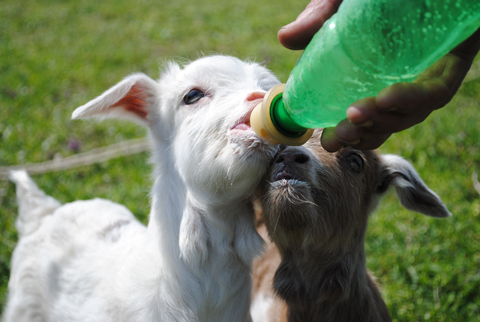
If a doe gives birth and cannot nurse her newborn kid, or if the newborn cannot nurse for any reason, getting colostrum into their system via a bottle is a must.  The best solution is to milk the dam and feed it back to the kid, heat-treating the colostrum if (CAE or other disease prevention) is preferred. 

If the dam cannot be milked, colostrum from another goat from the same farm is optimal.  This  the proper anti-bodies, unique to the farm, are contained in the colostrum.

The next best first-feeding solution is colostrum from a goat from another farm, preferably a nearby area. 

Colostrum is available in powdered form.  I personally do not agree with using it, unless absolutely nothing else is available.  Ready-made colostrum does not provide any life-saving protection from disease, however, it does provide initial nutrition.  I recommend to a goat owner that breeds to keep a frozen bottle of colostrum, or two, in their freezer. 

Please note:  if a newborn kid is chilled, unable to nurse, never attempt a forced feeding.  To ensure the organs in the body are warm enough to function properly, the kid’s internal temperature must fall within the correct range.  I outlined the steps that we take on our farm to assist chilled newborn kids in a blog post here.

Colostrum deprivation is a known condition that results from a lack of colostrum in a newborn kid’s first 6-12 hours of life.  The condition results in a sick newborn, one that does not fight infection well, and one that may not mature properly throughout their life.

Happy kidding and goat-raising!

Read Full Post »

Breaking Down Goat Milk – Unit #1 – Caprylic Acid

In personal care products and soaps there are many different types of “acids” that can be included that are good for the health of a person’s skin, one of which is caprylic acid. 

What is caprylic acid?

Caprylic acid is a fatty acid found in the milk of many mammals.  It can also be found in coconut and palm kernel oil.  Caprylic acid is very easily digested and absorbed.

Caprylic acid, along with caproi and capric (all named after goats), total 15% in goat milk fat.  For comparison purposes, cow’s milk contains 7%.

What is a fatty acid?

In easy (non-chemistry) terms, a fatty acid is a major component of fats that is used by the body for energy and tissue development (skin being of great importance), a major component of cellular lipids (lipids are fats that are very important to our bodies – they can help lubricate the joints, boost brain function, and promote vitamin absorption). 

A body cannot generate its own fatty acids, they must be ingested via nutrition or a supplement. 

Note:  As we researched caprylic acid we were surprised by the mass availability of it in supplement form.  It is used by many, even to fight off certain infections.  It makes the brain churn a bit more, one more thumb’s up for goat milk!

Read Full Post »

« Newer Posts - Older Posts »

Design a site like this with WordPress.com
Get started