Feeds:
Posts
Comments

Archive for the ‘Goat Care (and General Farm)’ Category

Cammille - Nubian Dairy Goat

Cammille - Nubian Dairy Goat

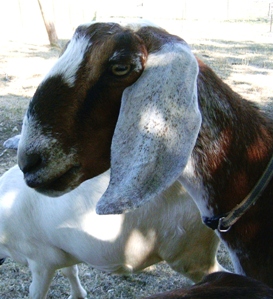
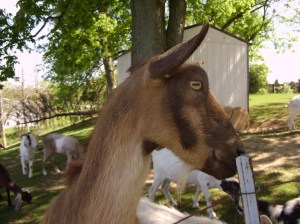
This is Cammille, one of my nubian dairy goats.  Her milk plays a big part in the goat milk soap that is made on my farm.   

Cammille is a smart doe.  As with most of my dairy goats, Cammille arrives at the milk room door twice a day, following the same pattern.  This season the order is Iris, Bonnie, Cammille, and Carmella.   Goats love patterns, in fact, some become rather upset when a normal routine is not followed.  They also know their own names.  They have individual personalities.  Cammille, for example, will not allow the milk inflations to be placed on her teats without first having access to the grain in her dish.  With Cammille, everything has to be pre-planned, in perfect order, before she arrives on the stand.  If not, a person had better hurry! She has a gentle nature, she does not kick, she more or less shifts from hoof to hoof, dancing, and the impatience quickens when food is not at her lips!

Dairy Goats 002

Athena - Snubian Dairy Goat

Athena is a young dairy doe.  She has not “freshened,” meaning, she has not given birth and gone “into milk” yet.  Athena is a 2nd generation snubian (cross between a saanan and a nubian).  I love snubian dairy goats.  They produce a nice volume of milk, and they retain the wonderful rich fat-laden nubian qualities in the milk they produce. 

Snubians are generally very laid back goats, easy to lead and train to the milk stand.  Athena does not fall short of those abilities.  Goats love to nibble with their lips (no teeth involved).  Athena has a habit of nibbling with her teeth, and it certainly can hurt! I am trying to break her of that wonderful practice! She loves to follow behind, and ouch, nibble!!!

Have you ever seen a goat bury their head in a huge pile of hay to find just the one morsel they were searching for? They cannot see through the hay, but they can smell, and amazingly their lips can feel better than most any other animal! Try to hold a young bottle-fed goat kid.  Try it without a bottle in your hand.  What you will get are nibbles.  Little nibbles to your neck, chin, earlobes, and they love to target the nose!

Goats…amazing animals.
Read Full Post »

Catching A Goat

Dairy Goats 002

Goats are smart animals.  Like any animal, they seem to possess certain senses that allow them to be keener than a human. 

Three goats were penciled on the calendar for wormings today.

The first goat was Chandra, as with most of my herd, no problem.  The old gal stood for her nasty tasting wormer. 

The second goat was a kid.  I knew my only recourse was to catch her while she was eating.  As I walked out the barn’s side door she saw me.  I pretended to look elsewhere.  Pretended that I was going to handle a few other does.  Too late.  She was already heading up the hill.  Silly me, I followed, insanely thinking she would just stop.  Of course she didn’t! No worming this morning.  I would have never caught her in the lot.

The third goat was a grown boer doe.  As I walked through the gate, there stood dozens of does happily munching hay.  Like something possessing super-radar abilities, how did the ONE know that I was going to worm her? Again, I attempted to not make eye contact, and pretended that I was heading into the crowd to tend to the other does.  I could see the ONE move out of the corner of my eye, move away from the herd.  At that point the cause was already lost.  In and out the barn we went until I decided I had to move on.  There were more animals to feed.

Just how do they know? It makes a person wonder, can they see the images in our brains? Seriously! They seem to sense our moods, our minds, our thoughts, and our movements mean everything to them.  And actually, I am very much aware of their movements as well.  Amazing animals they are!

By the way, the syringes full of wormer are ready.  I’ll catch them this evening when I distract them once again with feed.  Right?

Read Full Post »


Dairy Goats 001

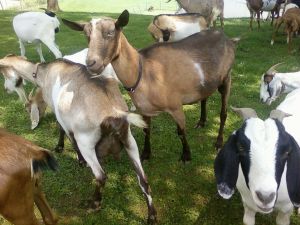
Similar to a grandmother who pulls the wallet full of photos out of her purse.  Here we go…girls on the hill photo day. 

Actually, today was paperwork day.   After I wrapped up things at the desk I decided I needed some new photos of the girls, along with some fresh air.  I was going to sit on the rock and spend some time with the crew, but they would not behave.  Imagine that! I’ll go back without the camera on a nice day soon.  We just may take a nap in the shade together. 

The photo above is Bonnie.  She is my oldest dairy doe.  A nice (but stubborn) alpine.  We have battled the barber pole worm during this humid and hot season.  Many of my girls have thinned out.  Some, like Bonnie and Iris, are holding on very well.  I will be glad for a bit of frost (but not glad for winter) to alleviate some of the de-worming. 

 Dairy Goats 002

Bonnie facing forward, Iris facing away.  These two alpines are my main milkers this season. 

  Dairy Goats 005

Akira is one of Bonnie’s offspring, a nubian/alpine cross.  She is growing large like her mother.  You can walk to the lot and call her name, Akira “answers” even if she is not within sight. 

  Dairy Goats 003

Carmella was my first dairy goat.  She has a unmistakable voice.  First of all, it carries, secondly, she makes a sound similar to “Whoooo!!!” Carmella is a tad bit expressive, especially when/if she gets spooked or upset.  I am totally in love with her.

Dairy Goats 004

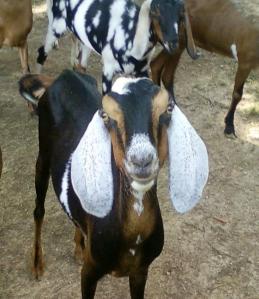
Aubree will be a part of the milkers in the future.  How about those long frosted nubian ears?

Read Full Post »


Momma

Momma

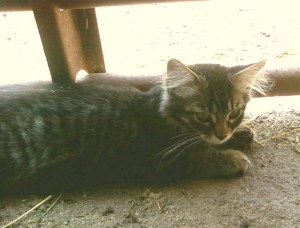
As I feed and milk the goats the rest of the hungry animals show up.  Momma cat comes in and takes a nap on the hay.  Who says these are the DOG days of summer?
Fluffy Boy

Fluffy Boy

The kittens are growing.  Fluffy Boy hangs out at the barn gate.  All of the cats congregate, waiting patiently for their treat of warm goat milk. 

Misc 002

Sharisse

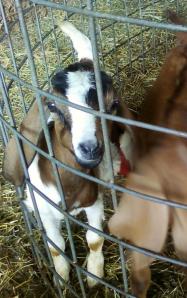
 The bottle kids wait patiently for milk as well.  In the summer their milk is fed cold.  I would imagine it is a treat to them in this hot spell!

Can you resist those nubian eyes?


Read Full Post »

On the way to the shop this morning, this is what I saw, remnants from the morning fog.  Funny how you do not see spider webs until they pick up some moisture.  Spider webs all over the farm.

Spider Web After The Fog

Spider Web After The Fog

This is what I made in the shop today.  Thought it was pretty too…

                                                                                 Misc 004

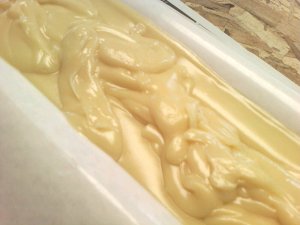
               Honeysuckle Scented Goat Milk Soap

Read Full Post »

Charolette 9-2-07Thought I would throw in some dairy goat statistics this evening.
Do you know which state had the largest number of reported dairy goats (at last count)? My first guess would have been California.  I was wrong.  Many years ago it was Ohio.  The correct answer is Wisconsin, at 40,000 head of dairy goats.  California follows with 37,000 head.  Iowa and Texas followed.  

Now, when you look at dairy goat operations, the numbers jumble just a bit.  Texas reined in 2007  with a reported 2,100 dairy goat operations.  Followed by California, Pennsylvania, Michigan, New York and Washington state.

With all of these dairy goat operations, with their capabilities of producing over 2,000 pounds of milk a year, the United States imports 50% of the dairy goat cheese consumed, most of it coming from France. Crazy man? I think so!

I love to make the goat cheese! But when I began researching someone I could co-op with in Ohio, or even from a surrounding state, I ran into a lot of opposition both money-wise and a lack of interest.  Ohio is not a good place to own a commercial dairy goat operation.  So, that is when I turned to goat milk soap.  I believe in turning my love of the goats into something sustainable. 

I drink my own goat milk raw, 2 cups a day.  I am a healthy person, so far, so good.  I believe goat milk is one the healthiest foods on the face of this planet (good for cholesterol, diabetes, allergies, the immune system, and more).  I cannot sell my milk, nor can I give it away.  Red tape, and I wish to not get myself in trouble.

I hope my future finds me at 80 years old, in a granny dress, milking a dairy goat, sassy and fit! I need to get the fit part right, first! That is my project this week, fitting up!!!

I will soon write an article on goat milk soap, how I still need to educate the public on its benefits, and even that it does exist!

Read Full Post »

Good afternoon!

Snubians are a goat breed that I have discussed before.

This particular doe is a 2nd generation snubian. Her dam is a snubian (sire pure bred nubian, dam pure bred saanan), her sire is an American nubian. I will register her as an American nubian. Love her peachy color, and I have high hopes she will also be good on the milkstand (as her dam is).

When purchasing a dairy doe always consider what your needs are beforehand. For example, I bought saanans because I wanted the milk volume, alpines as well. But I love the richness of the nubian milk.

Also, determine if you want a hefty dairy goat. My saanans are too thin for my liking. They put their all into their milk. And they come from lines of very thin goats while in milk. Ask a lot of questions before you buy your goat! Never be shy, and if you are not sure about an animal, do not purchase it.

You will also want to consider how long the doe remains in milk. One of the does that I purchased drops out of milk soon after the 3rd month mark which is not good for my needs. After I purchased the doe her prior owner told me that she had been the cause, she dried the doe off (took her out of milk) soon after her first few freshenings (kiddings/births). The milking pattern that a doe experiences early on generally follows through her entire career on the milk stand.

More dairy doe tidbits later…Happy Dairying!

pic 0159

Read Full Post »

Do you ever look at something most every day and are oblivious to what you are seeing?
I love a tid-bit of history now and then…
I have held these milk cans close to my heart since a friend gave them to us 9 years ago. Her husband passed away and she cleaned out a lot of her possessions. Bob and I were setting up house at the time, buying a farm, and the friend said, “You will enjoy these.”
A few days ago (not 9 years ago) I noticed the words on the can. The picture below is from the top of the lids, the sides of the cans are stamped Polk Milk Company, Berne Ind. I love anything related to dairy, it does not necessarily have to be related to goat milk.
Then I learned a bit more…

Before the advent of stainless steel tankers, there were milk trains that ran through dairy areas. In many cases the farmers toted their milk to small train stops (some no bigger than a garden or tool shack), and from there the milk train would carry the milk to the larger cities. Some of the private milk trains carried cans, some of the company owned trains had “milk tank” cars.
Come to find out, the milk company listed on my cans was from Indianapolis, Indiana. Berne is located in northern Indiana, known for its cow dairy farms and cheese, inhabited in the early years by Swiss Mennonites. Interesting! I can see the cans being transported back and forth between Berne and Indianapolis, both on a farmer’s wagon, and on the old train.
Then I started reading about the milk trains. There are songs, movies, and all sorts of jokes floating around about milk trains. But, truly, there were actual milk trains that transported milk across the countryside. And many times people caught the milk trains if they needed a lift somewhere, some even rode the train to school.

Back on the farm…the farmers would strain and consolidate the milk into the cans, and then cool the milk in a spring house, later in history in a bulk tank. Then, either the farmer or a coop truck would come around and pick up the cans and take them to a creamery, or they went directly to the milk train.
So…perhaps I am the one slow on learning, but the next time I see one of these old milk cans…I will remember that they do hold a lot of history!

Read Full Post »

I am a cheese fiend. I absolutely cannot keep much cheese in the house. How about you?

In my spare time (uh huh) I make goat milk cheese. Chevre is my favorite, especially when garlic and my farm-grown fresh chives are included. I love seeing the muslin bags hanging in my kitchen for 8 hours! It feels old world, not to make little of the great a sense of accomplishment that cheese making adds.

I also enjoy feta goat milk cheese. Oh man, my diet is on the line when I make a batch of feta. I bottled it up once with dried rosemary infused in olive oil. I dipped into that jar enough frequently enough to give myself a belly ache!

One of the easiest and quickest ways to get fresh cheese into the house is to make mozzarella.

Here a quick recipe that includes some microwave usage:

1 gallon milk
1.5 to 2 tsp. citric acid
1/4 tsp. liquid rennet
1/2 C cool water (not chlorinated)
Kosher salt to taste (not iodized)

Dissolve the citric acid in 1/4 C water.

Dissolve the rennet in 1/4 C water.

Pour the milk into a stainless steel or enamel pan. Add the citric acid solution. Stir well. Slowly heat the milk to 90 degrees. You will notice the milk begin to curdle.

At 90 degrees, add your rennet solution. Stir gently, in a top to bottom motion for approximately 1 minute.

Remove the pot from the heat source.

Allow the milk to set for 5 minutes. This allows the curd to form.

Using a long knife, cut the curd in a checkered or cubed pattern, in an approximate 1″ pattern.

Scoop the curds into a microwave safe bowl.

Press the curd with your hands. The goal is to release and pour off as much liquid (whey) as possible.

Microwave the curd on high for 1 minute.

Note: Use caution, the cheese and bowl will get hot! I wear thick rubber gloves during the process.

Remove the bowl from the microwave and quickly work the cheese with a spoon or your hands. Drain off the whey again.

Microwave 2 more times, 35 seconds each. Repeat the kneading, handling and draining each time.

Knead quickly now, as you would bread dough. You will begin to see the cheese firm up and become shiny. Add salt at this time, to taste.

The cheese should now be pliable, and able to be stretched.

You can form the cheese into a ball and drop it into ice water to cool, or you can roll it out and wrap it in wax paper. I prefer the wax paper.

The cheese is ready to eat once cooled.

It will stay fresh for many days wrapped in plastic wrap (after the original cooling).

Note:
-cow milk can be used (I cannot personally attest to that statement)
-lipase powder can be added (to give a stronger Italian taste, I prefer without)
-do not use aluminum pans when making this cheese
-do not use iodized salt..that is unless you like green cheese.

Have fun!


Read Full Post »

One of my younger nubian does, Aralynn, has been showing up outside of the lot each day. When I arrive at the barn in the evening she has been waiting for me in the driveway, next to the barn door. One morning I carried the full milk cans to my truck, and there she stood already. She didn’t wait long to escape that day. The good thing is, like many goats, she ends up in a place where she waits for me, she does not run off. With much unease, I kept thinking, “How and where is she coming out of the fence?,” seemingly right under my nose.

Sunday morning we made a trip around that particular lot with wire cutters, fence posts, fence post driver, the entire works in tow. We thought we had any possible escape route fixed.
Wrong…
I was very concerned about her getting out in the road. Concerned for her own safety, and for my liability. I already pay more than double farm insurance premium because of a similar accident involving one of our horses.

So this morning, as a final attempt, I asked my husband to help me spy.

As soon as I put that particular group of goats out of the barn I gave Bob a call.

He watched as well as he could from afar, and I glanced out of the barn window as often as I could.

Aralynn ate grain, ate some hay, then wandered up the hill.

I thought we had her spot figured out. Wrong. And, of course, she sensed that we were watching.

She came back down the hill. I watched her from inside the barn, through an old window. I could see she was not intent upon staying with the herd.
10 minutes later I saw her interest in some weeds outside of the fence. She was about 30 feet away from the barn, along the fence line.
At that moment I saw it happen. I saw one long dairy leg go outside of the fence. Then the second leg stepped forward. Like a well-oiled cat that could get slink through a mouse hole, the rest of her body slid through, lickity split, just like that.

There she was, in all of her glory, happily munching on goodies on the side of the embankment.

Ta-da!!!
She was slipping through a break in the fence where we had to cut horns loose last year, a gap no larger than 6″x6″. The fence would bounce back after her departure, so the gap looked innocent enough to us. No kidding, this small hole did not look big enough for a cat to squeeze through.
They always say, “If you can see through the fence…it might not hold the goats.”

I hardly have a bit of trouble with fencing, but this one got me good!

Problem solved…for now…until next time!

Read Full Post »

« Newer Posts - Older Posts »

Design a site like this with WordPress.com
Get started