Feeds:
Posts
Comments

Archive for the ‘Goat Care (and General Farm)’ Category

Today I arrived home a bit late.  The animals knew I was late.  I do believe they have internal sun clocks. 

The deep glare of all of the hungry critters, accompanied by the time I spent away from the farm (enjoying a beautiful countryside ride), brought out sheer appreciation of my farm life this evening.

They  were squealing…

Goats and Critters 007

Henrietta and Friends - Growing!

Caleb, our great Pyrenees mix, said…

Mom...I have done a good job today...I am hungry too! See me do my dance?!

I have been a good guard dog...now I am dancing for my food!

The cats were lined up at the gate…ready for warm goat milk…

Goats and Critters 009

More cats in the feed room…

Goats and Critters 013

Protecting the feed sacks...looking for a "live" snack...

Come on…are you going to feed us or take pictures all evening????

Goats and Critters 006

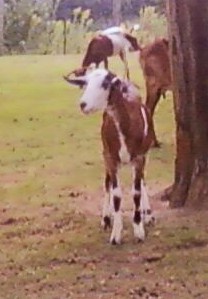
Left Camille (nubian), Right Carmella (nubian), Frosted ears in front (nubian/boer) Ms. Red

And the beautiful nubian that is finally beginning to grow…

Goats and Critters 002

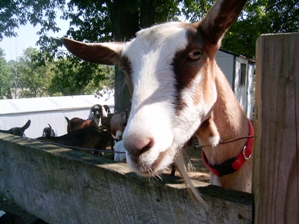
Amelie - Whom greets me with kisses on the chin and a nubian hum every day.

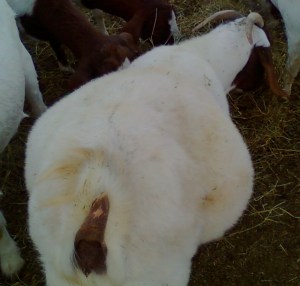
And those that seem to be expanding way too much…a boer doe that looks ready to pop…could not possibly have been bred in June!

Goats and Critters 011

Valentine - Going to need her own personal electric scooter soon!

What a troop they are! I love them all. 

Have a wonderful Friday!

Read Full Post »

Piglets Are Growing

Misc 002

Hungry Little Piglets

 
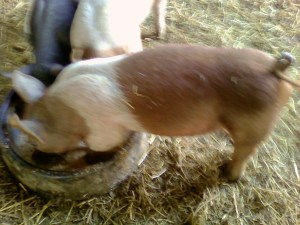
Piglets are about as difficult to photograph as kid goats.  They do not want to stand still, especially while eating.  Blur!
 
The piglets are growing by leaps and bounds.
 
Henrietta is queen of the trio.  She lets out a little squeal when she sees me at dinner time.
 
Like her little curled tail?
 
Misc 003

Henrietta Piglet

Read Full Post »


Iris 9-2-07

One of the questions that I receive frequently is, “How do I dry off a dairy doe?”

My best advice is to stop milking her.  If the doe was on grain while she was being milked, either cut the grain out of her diet, or cut the amount down considerably. 

A doe will continue to produce some milk as long as you milk her out.  The method of gradually cutting back on the milking schedule to dry a doe off never works for me.

Best bet:  cold turkey, stop milking. 

I have only had one case of mastitis in my milking herd.  The doe never had mastitis again in subsequent years.  For that particular doe, when I took her out of milk each year, I infused her teats with Tomorrow (a long-acting antibacterial product).  I infused and did not milk again until she freshened the following season.

Always watch for signs of mastitis:  doe is off feed, doe is standing away from the crowd, udder is hard/hot/swollen.  Keep in mind, however, the udder will swell for 3 or 4 days after you stop milking.  It takes a few days for the hormones to kick in and say, “No more milk!”  The body then begins to resorb the milk from the udder.

With a very thin doe, I do continue feeding some grain after I dry her off.  In most cases, however, worming her (if needed), and offering her good quality hay will put the weight back on.   I do not feed grain again until late in pregnancy, the 2nd or 3rd month.  Increase gradually as the due date nears.  A good quality alfalfa mix hay is a sufficient supplement otherwise.

I hope you found this article helpful.  Please let me know if you have additional questions.

Read Full Post »

The Piglets Just Arrived

The Piglets Just Arrived

Have you ever tried to tell a story but couldn’t get beyond the giggles well enough to talk?

I couldn’t get beyond the giggles to start this post.

Saturday morning we picked up the piglets. 

When we arrived at the pig farm the owner climbed into the pen.  All of the piglets were asleep, practically curled up under the straw.  Not for long.

Within moments there were little piglets running everywhere. 

It did not take long for the man to grab the male (the black and white piglet).  He carried him by his back legs over to me.  The piglet was still, calm as it could be.  I sensed that was a good way to carry a piglet, I could just tell.

What did I do?

I put my hands on the piglet, started to turn him over like you would a goat kid.  That was smart…very, very smart.  The piglet immediately went into action.  Squirming…almost out of my hands.  The man and my husband snickered, and luckily, between the two of them, caught him.

The two female piglets were not so easy to catch.  They ran through the mud for at least 20 minutes.  The owner had mud up and down himself, including in his eyes. 

When we arrived home with the piglets we backed the truck up to the temporary pen.  The first two came out of the crate easily, but the last one escaped our grasp.  I am telling you, the statement about something being slicker than a greased pig is absolutely, without a doubt, true! They are fat, smart, and quick.

Down the third piglet went, out of our hands, on the wrong side of the fence.  Across the lot she went. 

I have no idea how I did it, but I corralled her.  I guess years of catching goats taught me something.  It didn’t teach me how to keep my hands on a piglet, that’s for sure…tee hee.

Caleb, our pyrenees mix, is having a fit watching over his new piglets.  He has not left their side.  He does not know that the pigs are moving to their own set up in 3 or 4 days.  Temporary situation, sorry Caleb…you have goats to take care of.

Have a wonderful Sunday!

Read Full Post »

Amilee 001 Resized

It does not happen every day…you stumble upon a refreshingly different site and bookmark it immediately.  All Things Goat was one of those for me. 

All Things Goat is an online magazine brimming with articles written by ordinary people, people that have a passion for goats. 

I have been talking with Mary Ann and Naimhe Jeanne, creators of All Things Goat, for a few months.  All along thinking I wanted to give a shout out to their site.  Yesterday I decided to ask Mary Ann a few questions.  She gladly responded.

Me:  Was there anything in particular that prompted you to start All Things Goat?   Mary Ann:  Naimhe Jeanne and I actually met last winter on Twitter, talking about goats of course, and conceived of the site from there.

Mary Ann went on to say, “The overall intent of the site is to promote and link people in the goat world and all of its diversity.  Think of it as goat link love.  Naimhe Jeanne, who lives in northern Illinois, ahs goats.  I did as a child but no longer do and live in Madison, Wisconsin, where it’s kind of hard to sneak a goat into the backyard.”

Ah-ha! I see now, we are talking about goat love…nothing more, nothing less.

By the way, Mary Ann, I have been talking with Lylah Ledner, of Simple Home Living, about goats as well.  She is from an urban Arizona area.  I suggested she rent a barn, or a small piece of farmland, thinking it might fulfill the passion she still has for goats after 25 years of being apart from that love.  As I told Lylah, there are a lot of small lots out there that people no longer use.  Sometimes the land owners are overjoyed to have their barn and/or lots put to good use.  Something to think about. 

I asked Mary Ann a few more questions, such as:  What are the goals for All Things Goat? Is there anything we can do to help promote?

Before I sign off…I want to say thank you to All Things Goat for the wonderful site! Also, thank you for using my goat-related articles. 

I believe this excerpt from Naimhe Jeanne and Martha Ann answered many of my questions:

http://www.AllThingsGoat.com is an online magazine with news, photos, recipes and feature stories about meat, fiber and dairy goats.


We target an audience knowledgeable about goats, and those just becoming interested in goats, while showing those who have never thought of goats how our caprine friends improve the quality of life for many worldwide.


All Things Goat was created by Naimhe Jeanne and Martha Ann, carnivores both who believe in the humane treatment of goats from birth through death, regardless of whether they are a pet or raised for milk, meat or fiber.


Please look at our site and pass word of us to others in your community. We appreciate comments and always are looking for story ideas, photos, blogs and Web sites to keep All Things Goat fresh, lively and informative. 


If we can help you, please let us know.


Sincerely,

Naimhe Jeanne and Martha Ann

Read Full Post »

The Charm Farm

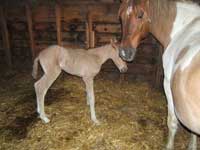
Horses at The Charm Farm

Horses at The Charm Farm

I wanted to tell you about a friend of mine, one that provides very special services, The Charm Farm.
 
The Charm Farm is the name given by special people that run a rescue for farm animals near Strasbourg, Saskatchewan (SK), Canada.
 
At The Charm Farm, many types of farm animals, such as:  horses, pigs, goats, cattle, sheep, and even chickens, are provided a bright future.  Many of these animals have been abandoned, sick or are elderly.  Animals in great need of temporary homes have received a loving place to stay at The Charm Farm. 
 
If there is anything you can do to help, this is not a gimmick, please do so, even if you can only pass the word along. 
 
I will be looking through my supplies for donations.  Animals are so very important to me.  I do not want to see a single one suffer.
 
Thank you, The Charm Farm! You set a beautiful example.
 
 
Disclaimer:  This is not a paid endorsement.


Read Full Post »

Aleecia - Nubian Doe

Aleecia - Nubian Doe

Management of goats involves much more than milking, feeding, worming and medication. 
 
Responsibility in maintaining the “numbers” is essential.  Meaning, focus on the goats that you can easily manage, and part with anything above that number.
 
If you are considering raising goats, keep your costs in mind.  Before you begin breeding your goats, or even before you purchase additional goats (or first goats), know what the feed costs are going to be.  Know what the fencing costs are going to be.  Shelter is another factor that must be considered.   Above all, stock the medicine cabinet before you purchase goats.  Do not assume they will not get sick, they will, and they do. 
 
When you begin breeding your goats, remember that a doe generally produces 2 or 3 kids per season. A goat herd multiplies quickly! That is why I part with goats once or twice a year. 
 
My farm rules are (because I cannot keep a lot of pets):  if you produce nice kids (even if it is only one nice kid per season), you raise your kids well, you are easily housed (you do not jump or destroy fences excessively), and if you are maintained without microscopic care (an animal that thrives on feed, browse, and an occasional worming and medication)…you are a keeper, you produce well for my farm.  And, very importantly, both the dairy and meat goats (boers) must be able to produce milk.  I have had to part with a few beautiful animals that showed a record of little or no milk.
 
You might say, “That sounds rather tough.”  Yes, it is.  But I have to run a herd with tight measurement.  If I didn’t, I would not be able to keep goats at all.
 
Now I need to prepare for the 2nd goat sale within the week.  Busy day ahead…and tomorrow I will smile at the remaining herd and say, “Get yourself ready for new milk and kids!”


Read Full Post »

 AA035400 photosearch.com piglet

With an oink, oink here…and an oink, oink there…Old MacDonald had a farm…E…I…E…I…O!

My husband took me out to the pig farm today.  I selected two female piglets.  The male piglet is coming from another farm.  It is not good to breed brothers and sisters in the pig world.

Pigs are affectionate?! Pigs are smart.  I saw it, or else I would have never believed it.

Mr. Red, the duroc sire, is a big boar.  When the wife called him out of the barn, Mr. Red stuck only his nose and ears out.   But that was enough for my first glimpse.  To self I said, “I thought pigs were smaller than that! That boy is huge!” Once the wife started to pet some of the other pigs, Mr. Red emerged.  He wanted attention too.

Ms. Raindrops, the hampshire mother, is a large off-white haired sow.  She, like the sire, loves attention. 

The piglets are 6-8 weeks old.  They have recently been weaned.  I will pick them up in about a week.

Now…and my friends, you need to help me here…I am NOT going to keep any of the piglets that are born in the future.  They are going to be sold.  I am not going into a full-scale pig business.  If I keep one, it will go to the freezer.

I promise!

Read Full Post »

Nubian Alpine

Nubian Alpine

Here’s hoping you have a wonderful Sunday!

The girls have had a good time recently.  Pretty scary to see a 175 pound gal whirlygigging her way down the side of a hill.  Saw one the other day rubbing her belly.  She started at the top of the slope, on her belly, inched all the way to bottom, still flat on her belly.  Needed a video camera.  Would have been quite the You Tube item.


Read Full Post »

Boer Goats

Tippie - Boer Doe

Tippie - Boer Doe

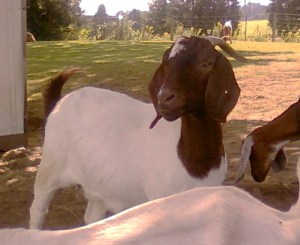
Most of the boer goats on my farm are not publicly slathered with the attention that the dairy does receive, so today I am honoring one of my boer does, Tippie.

Boer goats traditionally have white bodies and brown/red heads.  They developed this color pattern to fight the heat and dry climates.  They originated in the early 1900’s in South Africa, for meat production.  To this day, boer goats are a main stay in that region.  They are a sign of prosperity amongst African villages.

Boer goats entered the United States in 1993. 

Against popular belief, boer goats can be rather docile.  Tippie loves a good head rub, so does Annie, and so does our big stinky bucks.  Speaking of big…a boer doe can reach 200 pounds, the bucks can top out over 240 pounds.  Not all of my goats are that large, but some, such as Tippie, are (excuse the pun) tipping the scales. 

Did you notice a connection between Tippie and her name? She has a brown tail.

Read Full Post »

« Newer Posts - Older Posts »

Design a site like this with WordPress.com
Get started