Posts Tagged ‘Goats’
Goat Kidding Has Officially Started
Posted in Goat Care (and General Farm), tagged Goats, Kidding on February 23, 2009| 7 Comments »
Restoration
Posted in Goat Care (and General Farm), tagged Goats, Reflections on February 22, 2009| 2 Comments »
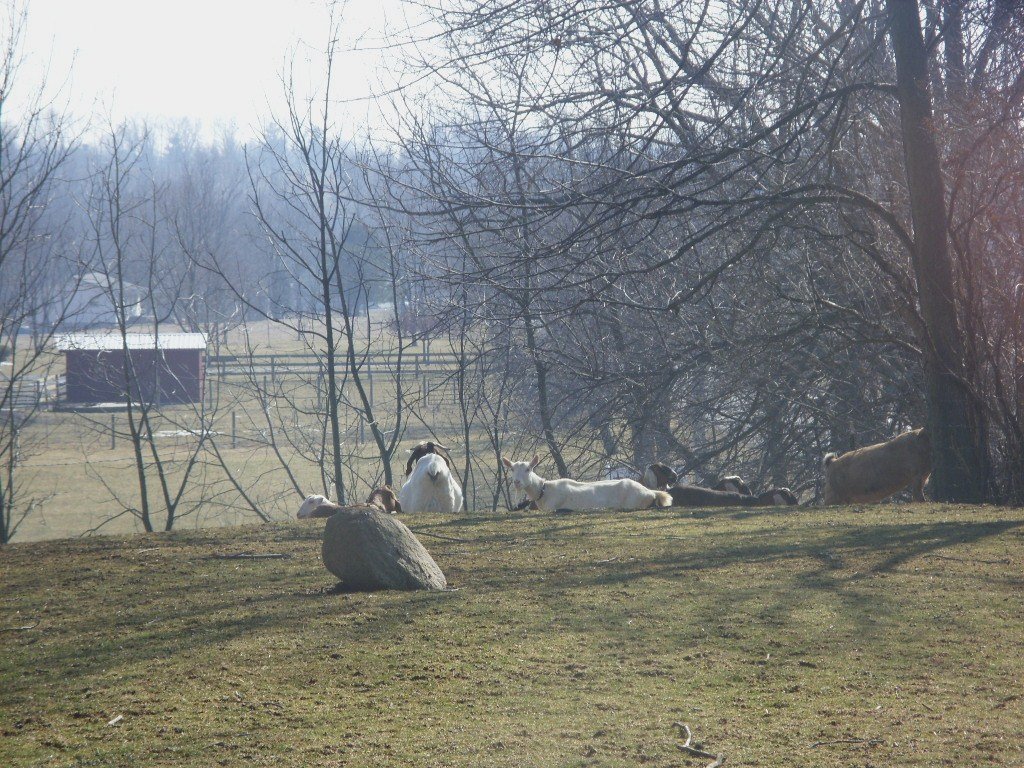
Goats On The Hill
Posted in Goat Care (and General Farm), tagged Goats on February 8, 2009| 5 Comments »
Girls On The Hill After The Snow And Ice
Posted in Goat Care (and General Farm), tagged Goats on January 31, 2009| 8 Comments »
The kids got to run today, and they really enjoyed themselves. We had several things that kept part of the herd in the barn this week. We had snow, thick ice, snow again, and then the side door that the dairy herd exits from froze solidly shut. Today they got to experience the great escape!
The doelings in this photo range in age from 6 to 10 months.
The doe second to the left in the photo is nic-named Ski Slope because of her fun ears. Her mother is an american nubian, her daddy is an american alpine. He made a sneak midnight visit at some point, obviously, and returned home before we caught him. Tee hee. Anyhow, she is a nice doe. A chatter box. A joy.
The photo below is a close up of one of the alpine doeling twins, the youngest kids on the farm (until we have one tonight, perhaps).
I worked in the shop most of the morning. Today was a lotion making day. I have an upcoming store placement that I am preparing for.

Does Ready To Kid
Posted in Goat Care (and General Farm), tagged Goats, Kidding on January 29, 2009| 14 Comments »
The Holstein’s Of The Dairy Goats
Posted in Goat Care (and General Farm), tagged Dairy, Goats on January 26, 2009| 13 Comments »
Many people have asked me, “What breed are the best dairy goat milkers?” Hands down, my vote is a snubian. What is a snubian? A cross between a saanan and a nubian.
For those of you not familiar with goats, you really can catch a lot of flack for choosing one breed over the other. But I live in my own little goat world out here, preferring to not show, and also preferring to see who becomes the best milkers on my farm. I mix and match, and I’ll admit, I have some “different looking” dairy goats from time to time.
The doe in the photograph is Chameaqua. Her dam is an American Saanan, her sire is a pure bred Nubian. The genes for white are fairly strong in this breeding. The ears are not pendulous, as in a nubian, but they are not erect as in a saanan.
My saanans come from a very thin line. I wish they would put on weight, they tend to look more on the emaciated side. Someone once asked me, after they connected to my dam’s lines, “Do they put their food into their hips, or into their milk?” Without a single thought, they put their energy sources into their milk. They eat like horses, and milk like crazy.
The snubians have the best of both worlds. They are blessed with the wonderful richness of nubian milk (very high fat content in nubian goat milk), and they carry through with the very high volume of a saanan.
I have two snubians up and coming behind Chameaqua. I cannot wait to see if they also naturally take to the milk stand!
One more excellent point for snubians, they grow like weeds! I have never, ever, had a kid on my farm that grew like these youngsters do.
One particular snubian (thank you to the ADGA.org list that I copied from) belongs to Yvonne Roberts, a friend that I chat with from time to time. The doe is amongst the top 5 experimental breed milkers in the United States (GCH R R RESOURCES PEPPERMINT STICK 2*M). Way to go Ms. Peppermint and Yvonne!
Well, that is my goat talk for today. I’ll come back next week and showcase another.
Happy Monday! Stay dry…and hopefully we will all be able to post while the latest winter storm pushes its way through.
Dairy Goat Milk Transporting
Posted in Goat Care (and General Farm), tagged Dairy, Goats on January 24, 2009| 6 Comments »
I love visiting the local cow dairies. I love dairy cows. I am a city girl, gone country 8 years ago. You should hear the comments that emit from my mouth. I do not look at houses or cars. I comment about pick up trucks, tractors, barns, and more importantly, udders. I constantly look at animals, udders, backs. Did I ever think I would know the difference between the profile of a dairy cow or a beef cow? LOL! I do. Look at the hips, it shows. If I were rich, and could afford the large dairy barns, huge amounts of pasture, and if I could pay the helping hands, I would run both a cow and goat dairy!
As I looked at the calendar this morning I realized that my dairy hiatis is about to end. Cammille will freshen once again sometime around 1/19/09. The rest of the girls follow shortly behind. Until then, I am working out of the freezers. Yes, that is freezer with an “s,” plural, and I could easily say plural(s), if there were such a word!
I have a commercial freezer in my soap shop, filled to the brim with milk. My kitchen side by side freezer is filled with milk. I have an upright freezer in my laundry room, filled with milk. My side by side in the barn is filled with milk. My friend’s freezer, 15 minutes way, is filled with milk. Gulp! I think I have milk. Milk…good for the soul.
Normally, no matter when I put the boer buck in with the girls, they decide to start kidding out sometime between 1/29-2/2. And, normally, there are several things occuring around that date. Last year it was a blizzard. I have plenty of blizzard kid pics (in the house) from that week last year. The year before, it was a siberian express, meaning, the temps were below zero each morning and kids were hitting the ground in numbers. I had 20 kids in the house for 3 weeks! More on that someday. It was a hilarious, exhausting, fiasco!
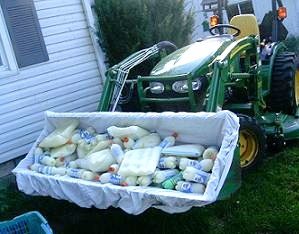
This pic has a story behind it. One of the freezers is not frost free. I still had girls in milk when we bought the commercial freezer for the soap shop. So, my husband came up with a milk transport plan. Our green machine came out, lined with a twin size fitted sheet, and the milk was transported out and away from the old freezer. It saved on the backs, and it brought on some fun, a LOT of laughter! My husband and I do some goofy stuff, and laugh at the same antics for many-many years. Anyhow, we proceded to fill the commercial freezer with the transported milk and was able to defrost the old freezer. Thank you to the green machine!
Why so much milk in the freezers? A newborn goat kid takes a lot of bottles, and even when I resort to milk replacer, I mix it with goat milk. If a kid takes 2 bottles a day, multiply that by 3 months, and multiply that by 20-something kids! I bottle feed all dairy kids. A freezer empties very quickly.
So far this year, no boer kids have been born in abnormal temps, nor any adverse weather, in fact, no boer kids yet at all. Someone asked me a few days ago, “Are they pregnant?” Yeah, they are! The first possible due date was 12/9, but guess what? They know it is not yet 1/29, or 2/2…it is on the way…they are holding out. Of course, they are goats!
Take care…have a great Saturday!
Dreaming of Sunshine
Posted in Goat Care (and General Farm), tagged Goats on January 17, 2009| 5 Comments »
Winter Temperatures and Livestock
Posted in Goat Care (and General Farm), tagged Goats on January 13, 2009| 6 Comments »
People often ask me how cold is too cold for the livestock? I will aim my response at cattle and goats.
In my opinion, the answer greatly depends upon the condition of the animal. An animal in good body condition, with a nice winter coat, no present illnesses, can do well in lower temperatures. I even believe, similar to our local Mennonites that urge their children to play outside in the winter, animals are healthier when they romp outdoors throughout various seasons.
The general rule of thumb for outdoor temperature safety is 32 degrees. With a lack of wind, sunshine, and no snow or rain in the picture, animals can be comfortable at 32 degrees. When the temperature drops below that point, ensure the animals have a place where they can take shelter to warmer when needed.
If it is raining, the rule of thumb is 60 degrees. This does not mean that the animals cannot be left in the pasture at 59 degrees, on a day with light sprinkles. When the temperatures drop below 60 degrees, and the coat of an animal becomes wet (down to the skin), it becomes more difficult for them to retain their body heat. Adequate shelter, such as a lean to, should be provided.
In the winter, animals have difficulty browsing and grazing, so quality hay is more important. Grain is a good additive, but quality hay is what keeps the animal warm. The better quality hay, the better a ruminant animal is able to regulate their own body temperatures.
A few more words…livestock generally do not shiver. When they shiver, they might be too cold, or could be ill. There are exceptions to this rule. I do have one full grown nubian doe that shivers every morning, but only because she is excited to get outdoors. Newborn animals cannot retain their own body heat very well, and they are susceptible to frostbite, the outlines above are for animals that are well on their feet.
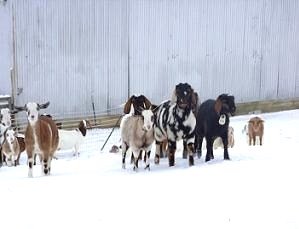
The picture above was taken from my office winter last winter. Today the girls are indoors, the windchill is in the single digits, with snow flurries.
I plan to get back into the soap room tomorrow. I need about 7 new batches of lotions on the shelves by Monday. That is my goal date for the website addition. I had to run to town today, picked up new stick blenders. I have a habit of dropping them on the floor. That is quite the no-no on a concrete shop floor!
Take care…stay warm!!!
Sunday On The Farm
Posted in All In A Day's Time, tagged Goats, Weather, Weekends on January 11, 2009| 15 Comments »