Feeds:
Posts
Comments

Posts Tagged ‘Goats’

Well, there is one thing for certain when you own goats, you never know everything for certain.
But isn’t that true about life, expect the ups, downs, in and outs, and the surprises? If we don’t expect them, we will be in a load of trouble.
Today is day 155 for Bonnie, my oldest dairy doe. I assumed she had not settled. No udder, tight ligaments, and no signs of pregnancy, except her voracious appetite and pushiness with other does has been a bit more pronounced the last couple of days. As I let her out of the gate this morning she moved with a noticible amount of slowness. I immediately said out loud, “Oh oh,” as I reached between her legs as she passed through. Yep, milk came in. Giggle. We are not finished with the kidding season yet.
The old girl is outside today, walking around like nothing is up, now loosening in the ligaments, and beginning to show signs of impending labor. I keep hoping for it to start, as we are having friends over for cards tonight for the first time in months. But, no, nature isn’t quite on that schedule today. And that is okay.
Waiting…waiting…and it will happen, in it’s own time. It is the code of the doe, she will kid when she is good and ready. πŸ™‚
Have a great Saturday! It is beautiful here today!

Read Full Post »

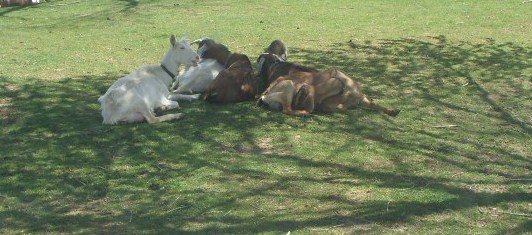
When you own animals, and especially livestock, they sometimes give you a “heart attack” when you catch them lounging. I took this picture from afar, lost a bit of clarity from the distance, but there sat a group of girls, many of them being my dairy girls in milk, all twisted around, enjoying this gorgeous 80 degree, breezy and sunny day! Look at Carmella (far right), twisted around like a pretzel.

The worst look to a sleeping animal (horse, cow, goat, and even dog) is when they lay completely flat, motionless, on their side. Like looking at a newborn baby, one deep in sleep, are they breathing? Let out a sigh of relief, they are!

As a livestock owner you learn to sharpen your senses when you look at your animals. It becomes internal habit. When you glance at the animals it goes a lot further than enjoyment. You look at actions, body movements, eating patterns, and even how they “speak.” A herder catches a goat that is “off,” for example, early on just by seeing the slightest change in their behavior.

By the way…I received more questions, and I have more answers, for part III of the dairy goat diary, coming up in a few days!

Anyhow…I am just sharing a sunny day photo taken from the office window a few moments ago.

Read Full Post »

I was not sure what to talk about today, but it all gelled!

I had a busy morning with the goats, trying to get out of the barn and clean up before the order of grain was delivered, also knowing that I needed to get to Country Home Crafts where some of my products are displayed to deliver some of the newest goat milk soaps. I got it all accomplished, but it left me feeling slightly depleted.

After lunch I worked on putting an order together and did an inventory of the essential oils and fragrances in the shop.

A few days ago, after receiving some really good questions (in my opinion), I talked about my farm schedule and answered a few questions in the blog post The Goat Dairy Farm Diary (To Answer Questions).

Today, Lynnanne asked a few more great questions…it gave me something to write about!

“I’m curious as to why the dairy goats are bottle fed and most of the meat goats are not??” It is fairly common practice to bottle raise vs. dam raise dairy animals (calves, lambs, and goats). This is done for several reasons, mainly to protect and ensure the health of the udder. In commercial dairy operations the kids are pulled and fed milk replacer, the goat milk is gathered and sold, or the milk is used to make cheese. In my situation, I choose to bottle feed the dairy kids to protect the udder, and to prevent disease in the kids (that can be passed through the dam’s milk, such as CAE). My hope is to someday have the commercial dairy (goat or cow) that I dream of. I pasteurize the goat milk that I collect, using some of the milk in the soap and goat milk lotion, and during deficit times I will mix part milk replacer with part goat milk when I bottle feed. As you know, many of us follow different practices with our herds. I am not opposed to leaving dairy kids on the dams. My philosophy with fellow herders or farmers is, what works for you is best!

“What prompted you to go into goats and goat milk soap?” The interest in soap came first. I began making soap in 2003 (with a soap interest that began as a youngster). My initial investment in goats was geared towards meat goats (boers), but as soon as I got my first dairy goat (Carmella, a nubian) I was hooked. After not making soap for a few years, and after realizing that it was very difficult to obtain a dairy license in Ohio, and also realizing that I was itching to make soap again, I decided to get the goat milk soap ball rolling, full speed ahead. And again, I was hooked. I love goat milk soap! And I am very excited to be able to show a product that is crafted as a product from my hard work on the farm. There is nothing like fresh goat milk. I drink it, I make cheese out of it, and of course, soap and lotion too!

I am ready for more questions…I thank you!!

Read Full Post »

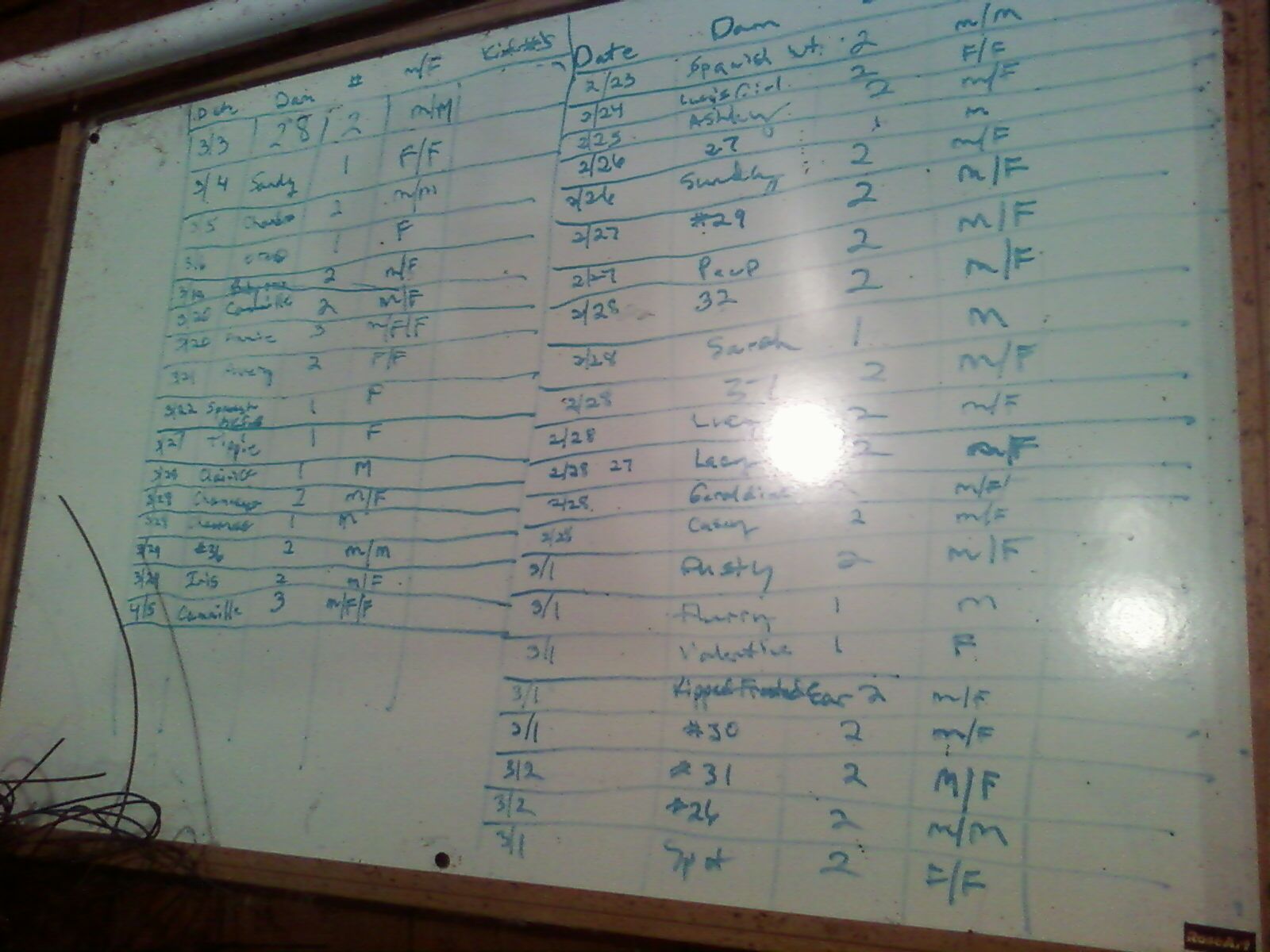
A small break from goat milk soap soap talk to answer some farm related questions…this is one of my barn white boards, photo taken a few weeks ago.

On this board I record kidding information (date, dam’s name or ear tag number, the number of kids, and the kid’s sex).

This board plays an important role on my farm. It determines when the kids are weaned (either bottle or dam raised), and it helps me to determine when a kid can be sold. And, since I am part of the USDA Scrapies program, when the information is copied to paper, it is the record keeping that I am held to.

I’ll answer some wonderful questions now:

Do you dam or bottle raise your kids? Both. The boer kids are dam raised (except for those that are special needs cases, such as an abandoned or very sick kid). The dairy kids are always bottle raised on pasteurized milk. When there is a deficit in milk, and there is one right now, the kids nurse on both fresh goat milk and a fraction of milk replacer. I always inch more towards the fresh goat milk (pasteurized) due to the cost, and mostly due to the nutritional value in the “real” goat milk. I have 29 bottle kids today.

How long does it take you to milk? That is difficult to say. It depends upon how many does are in milk and what time of day it is. My day runs like this: 6:30-9:00 (answer email, check in on blog and contacts, prepare milk, eat breakfast, place orders out for shipment), 9:00-10:45 (feed and milk), 10:45-11:00 (break), 11:00-11:30 (prepare for making soap or other bath products, answer email, or prepare for what I plan to do after lunch), 11:30-12:15 (lunch), 12:15-2:30 (make soap or bath products, work on website, pasteurize milk, post on blog, answer email, and other business related duties), 2:30-3:00 (rest), 3:00-4:00 (prepare milk for bottle kids and clean up), 4:00-5:30 (feed and milk), 5:30-6:00 (rest, answer email, read online), 6:00-6:30 (prepare dinner), 6:30-9:00 (prepare customer orders, answer email, relax, and work anything else in that I can, along with another short feeding for the bottle kids). 9:00 (call a friend and then I zombie out). I consider anything after that time “family” time. I love it…shut the door, turn off the phone, enjoy the quiet!

How many does do you keep in milk? Right now I have 8, I generally keep 11 on rotation.

Do you take vacations? No. I do not miss vacations. I do, sometimes, feel as if I am chasing my tail. My schedule is not always as tight as it is right now. After the kids are born the herd more than doubles. But later, after months begin to pass, there are certain times in the year where feeding can take 20 minutes, twice a day. But then there are other duties to catch up on such as hoove trimming (which is needed right now).

How long are the kids on milk? A kid that is a wether (castrated male), one that has grown well, is weaned between 2 1/2 and 3 months old. A doeling is left on the boer dam until the next breeding season. The doeling is then removed to ensure she is not bred at a young age. And kid’s are fed different amounts of milk depending upon their age, and at different times (hence the importance of the white board record keeping again). Right now I have 25 goats on 2 bottles a day, some on 1/2 bottles (10 ounces), some on full bottles twice a day, and 4 that are on 3 feedings a day (full bottles).

I hope that helps with some of your questions, and let me tell you this, your questions are more than okay to ask!

I also keep calendar’s in the barn of due dates, wormings (only when needed), medications (I try to go as natural as possible on this farm), and other records. Fun times…now I need a nap, but I am late for preparing milk for feeding! πŸ™‚

Read Full Post »

I have a few blog posts to publish about the farm duties. This one surrounds the milking process.

In the photo, left to right is udder wash, dish soap, bleach, the milk bucket with inflators, the Fight Bac spray, clean towels and rags, and the milk buckets to carry the milk back up to the house (or place in the barn refrigerator if I have chores to run before returning to the house).

In the photo, above the milk bucket are the PVC pipes, pressure guage, etc.., for the milk machine itself. The milk machine is a very old Surge model, not pictured. It is located on the other side the room. I actually have two machines, one as a back up. My husband ran vacuum lines around the room so that I would not have to deal with the machine running on the milking side of things. I love to hear the old machine run, by the way! I check the oil once a year, always at a good level. The belt has been in good shape for a long time. It just plugs away. I am afraid I might jinx myself if I say more.

I generally have 11 girls in milk. Right now I have 7. I use a machine because it speeds the process up, and because I have carpel tunnel syndrome. Milking out one single doe by hand is a struggle, but a very peaceful task for me.

Milking should be done at a set time each day. I milk twice a day. My milkings are not spaced 12 hours apart, but they are consistently done within the same 30-45 minutes. If a milk schedule is off, even by a few hours, and even on one day, the does can, and probably will, based on my experience, begin to produce less milk. The hormones in the body say, “Hey, we are not so needed any more, lets shut this milk stand down!” Well, something like that. πŸ™‚

My girls normally line up outside of the milk room door. Each year we fall into a pattern, and the goats pick up on it. They know the order in which they come into the door, and usually I do not have to call a single name to get them to do what they need to do. Goats like patterns and are not very easy to deal with when things are amiss.

Milking involves (the short list):
-Cleaning and drying the udder (clean towels to wash, clean towels to dry each udder with)
-Milking (but not completely stripping out, to prevent mastitis)
-Treating the teats after each milking (mastitis prevention)
-Pouring the milk into the milk cans for transportation
-Scrubbing the empty milk bucket with a brush and running sanitizer and water, several times, through the hoses, inflators and the bucket

Milk handling (the short list):
-Cool the milk as soon as possible (never leave it sit warm, unless pasteurizing immediately)
-Filtering the milk
-Pasteurizing (and I have drank it raw, filtered and chilled immediately, a real treat)
-Cooling the milk again. I cool my milk in the freezer to ensure it cools as soon as possible. Using an ice bath is very helpful as well. Licensed dairy’s are required to chill the milk to a certain temperature in a very short period of time. I am not licensed as a dairy (the soap company is), therefore I cannot sell my milk to anyone, but I do my best to keep the milk as fresh as possible for bottling and/or freezing. Milk can be kept frozen for up to one year.

I hope you enjoyed the visit. Next I am going to provide a farm journal of sorts, shortened version.

Read Full Post »

Yesterday evening I was washing dishes and heard the unmistakable sound of a kid goat in trouble. The larger goats, with horns, can really put out a holler when they have their heads stuck. The younger kids tend to not get stuck, but it happens from time to time. They are “Curious George’s,” as I like to call them!
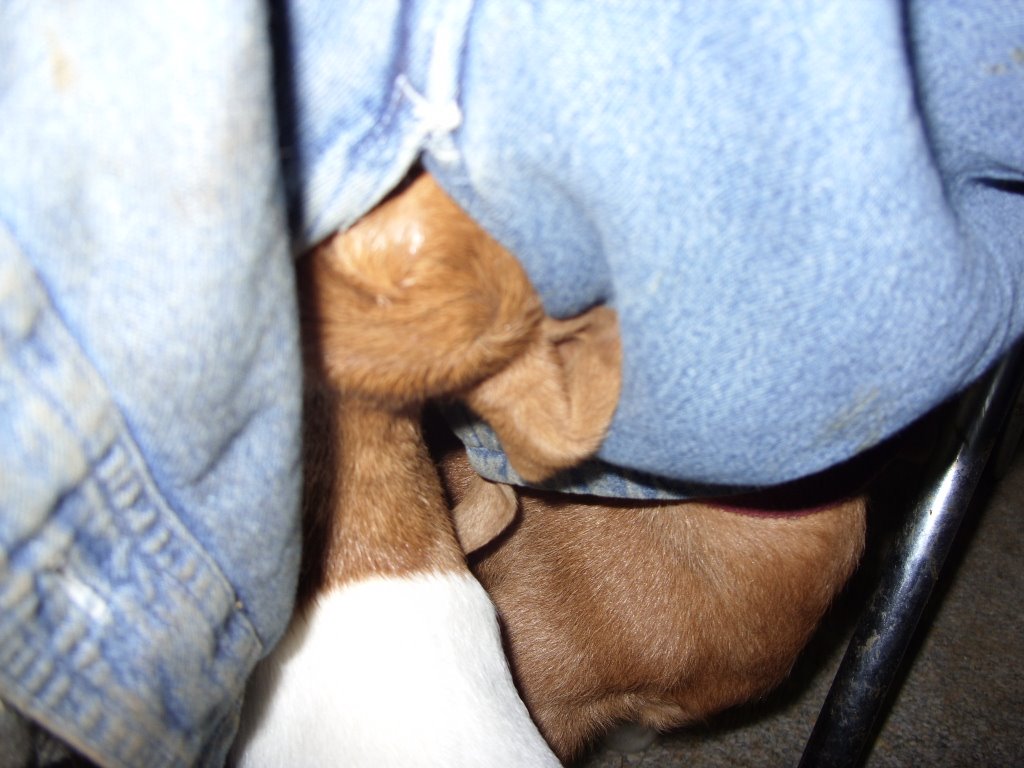
A moment after I heard the kid goat obviously working hard at releasing herself, I heard hysterical giggles from my husband. He calls to me, “Come here, quickly!” Barely able to talk through his laughter, he says, “Hurry, you have to see this!” I had my camera next to me since I had been taking photos of the new Annie’s Goat Hill goat milk soaps a few moments earlier.

The tiny doeling had her head stuck in his coat pocket! Curiousity had gotten the best of her. She was fine. But then we laughed again until tears flowed because the kid then decided to just stand there, head stuck in all of her glory. She didn’t seem to mind. Tee hee…there I go again!

It is a busy Monday! I have a newsletter to work on (for this week’s release), paperwork at the desk, and some grain for the goats to pick up. I squeeze a lot of activity in between feedings.

Have a wonderful day!

Read Full Post »

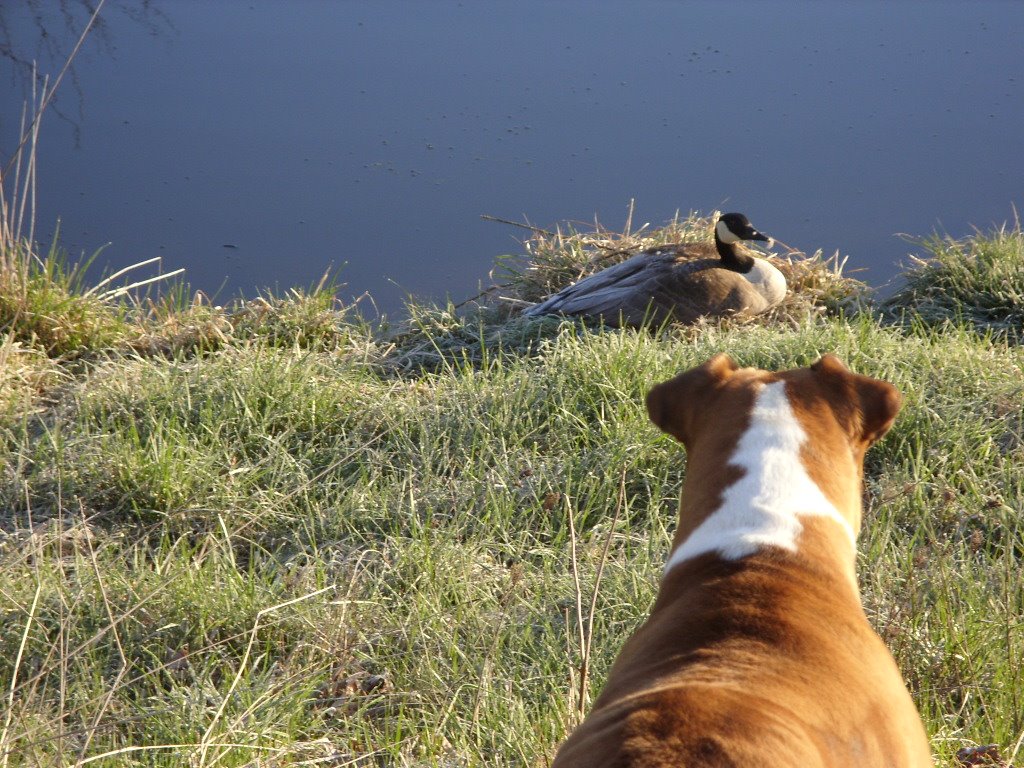
Each spring a pair of canadian geese return to our pond. We would like to believe they are the same pair, and as those with knowledge have written, they likely are the same pair. They do mate for life and they do return to the same “home” spot year after year.

About 4 evenings ago I noticed momma goose making a next. She is now resting on it.

We have heavy frost this morning and something told me to walk down to the pond with camera in hand. Tyra went with me. She does not bother anything that belongs on our farm. As we gazed at the goose, I realized that she indeed has frost on her back. She has been setting for a very long time, obviously, and is not going to give up. Can you imagine?

In about 18 days we should see the fuzzy yellow goslings emerge. And then we will begin to enjoy the rest of the pond activities as we see the young ones grow and learn. It never ceases to amaze me how geese teach with body language.

Have a wonderful Easter!

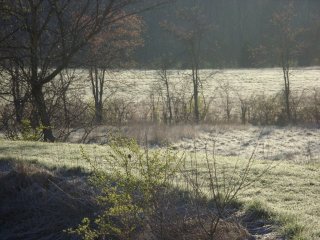
Heavy frost this morning on the back lots –

Read Full Post »

Kids do not want to sit still for photographing. Nope, they do not!

This particular doeling my husband nic-named Tiny Tot. In our household my husband is in charge of feeding the youngest of the dairy kids. He comes up with some great names, and falls in love with them all the same.

Tiny Tot is growing like a weed at 20 ounces of milk at a sitting (our set maximum), but her little hooves are no bigger than the tip of my thumb. Her momma is a pure bred nubian, dad is a full blood boer. Tiny Tot arrived with the dairy body conformations and the boer color markings. She will grow out to a nice doe size, no doubt about it.

She says, “Sorry for the blur…I am ready for the BOTTLE!!!”

Read Full Post »

I have a few escape artists on the prowl. They love to climb.

I was bottle feeding some of the kids and did not think anything about the door to the feed and milk room being open. Actually, my thought was that they can do no harm because they would not be able to climb 4 bales high. What was I thinking? I knew better. I did not start raising goats yesterday. Tee hee.

I heard a crash and 5 young goats came running out. I still did not get excited.

After finishing the bottles, I gathered up my bottle bucket and my sitting stool and headed to the feed room. Oh oh. What a mess I found! I had left a 1/3 of a bale (untied) on top of the bales of hay. It had been knocked to the floor. Oh yeah, you betcha’, it was pretty well scattered. Another bale, still tied, was pushed to the ground. And there were young goats hopping everywhere. Yes, that is hay stacked 4 bales deep.

And, like a comedy act, when they realized they were going to have to leave, they jumped, 4 bales down, straight out the door. How do they do it? πŸ™‚

Read Full Post »

I was bottle feeding in the barn yesterday and saw heads bob up and down, out of the wheel barrow. I quietly removed my phone from my pocket to catch a moment of the scene. One (doe on the right) almost fled the scene (notice the open mouth, the baa warning signal was being announced).

They love the fresh scrap hay in the bottom of the wheel barrow, it is quite the enterprise to them now!

Read Full Post »

« Newer Posts - Older Posts »

Design a site like this with WordPress.com
Get started