
The girls say…it will be back soon! 🙂
Posted in Goat Care (and General Farm), tagged Goats on January 17, 2009| 5 Comments »
Posted in Goat Care (and General Farm), tagged Goats on January 13, 2009| 6 Comments »
 People often ask me how cold is too cold for the livestock? I will aim my response at cattle and goats.
In my opinion, the answer greatly depends upon the condition of the animal. An animal in good body condition, with a nice winter coat, no present illnesses, can do well in lower temperatures. I even believe, similar to our local Mennonites that urge their children to play outside in the winter, animals are healthier when they romp outdoors throughout various seasons.
The general rule of thumb for outdoor temperature safety is 32 degrees. With a lack of wind, sunshine, and no snow or rain in the picture, animals can be comfortable at 32 degrees. When the temperature drops below that point, ensure the animals have a place where they can take shelter to warmer when needed.
If it is raining, the rule of thumb is 60 degrees. This does not mean that the animals cannot be left in the pasture at 59 degrees, on a day with light sprinkles. When the temperatures drop below 60 degrees, and the coat of an animal becomes wet (down to the skin), it becomes more difficult for them to retain their body heat. Adequate shelter, such as a lean to, should be provided.
In the winter, animals have difficulty browsing and grazing, so quality hay is more important. Grain is a good additive, but quality hay is what keeps the animal warm. The better quality hay, the better a ruminant animal is able to regulate their own body temperatures.
A few more words…livestock generally do not shiver. When they shiver, they might be too cold, or could be ill. There are exceptions to this rule. I do have one full grown nubian doe that shivers every morning, but only because she is excited to get outdoors. Newborn animals cannot retain their own body heat very well, and they are susceptible to frostbite, the outlines above are for animals that are well on their feet.
The picture above was taken from my office winter last winter. Today the girls are indoors, the windchill is in the single digits, with snow flurries.
I plan to get back into the soap room tomorrow. I need about 7 new batches of lotions on the shelves by Monday. That is my goal date for the website addition. I had to run to town today, picked up new stick blenders. I have a habit of dropping them on the floor. That is quite the no-no on a concrete shop floor!
Take care…stay warm!!!
Posted in Goat Care (and General Farm), Health, tagged Goats on January 10, 2009| 5 Comments »
 When I enter the barn in the mornings, I always stop and give attention to the goats that are obviously wanting it. There is something about the eyes of a goat…you have to love one to know what I mean. They speak through their eyes, there is a definite connection. Sometimes I give attention to those that do not want it. Once they trust a human, and learn to like being touched, they seem to be much hardier animals. For those of you that raise goats, you know as well as I do, there will always be more than a few that seem to crave attention! As I made my rounds this morning, and as I held Aleecia’s face between my gloved hands, kissing her on top of her head (yes, I kiss goats), I remembered an article that I had read a few weeks back about the water needs of animals. I do not know where that article is at. This is my version.
Water is the number one need in both humans and animals. Animals, particularly livestock, actually need more water in the winter months than they do in the summer months. It is imperative, especially to a goat, to keep the water buckets clean and free of debris. Keeping the buckets in a position where they do not get soiled can be a challenge, but is a must. Contrary to the old popular statement, goats will not eat anything and everything. If their water bucket is not crystal clear, they will not drink water. I truly believe they would die of thirst before drinking from a filthy bucket.
There is conflicting information regarding how much water a goat will actually drink on a daily basis. And who is to say? Water consumption depends upon a lot of variables. I estimate the average needs on a good day right at a gallon a day, per goat. I have to pay close to attention to water consumption because we have tricky water amounts available in this area (the goats come first). It is said that goats require 4 times the amount of water than the dry matter that they eat. By my own calculations, this is closely true (based on the estimated weight of the grain and hay I feed each goat per day). Rule of thumb, provide as much water as they want. I want to add that pregnant goats tend to need a lot more water when later in pregnancy, and this, in itself, makes it even more important to ensure the water buckets are clean, and not frozen.
Now I will touch on human water needs. Our bodies are made up of 60-70% water. This means that we need to take in fluids to keep our internal balance in check. Some say 8-10, 8 ounce, glasses of water a day. Others say it is a matter of math, simply take your body weight and divide it in half to determine the minimum amount of water needed per day. Example: a person that weighs 150 pounds should drink no less than 75 ounces of water per day.
We all need pure water on a daily basis, but some of this can be obtained through drinking decaffeinated drinks, fruit juices, and milk. But, to keep the skin healthy, and to help regulate the organs and body weight, there is nothing better than water!
Many people do not know the symptoms of mild dehydration. Before I list these symptoms, I will never forget the day that I had a terrible headache. I felt lousy! Nothing seemed to help. I tried aspirin, then ibuprofen later in the day, I tried a nap, and the list goes on. Eventually I drank a bottle of water. Within 5 minutes my headache disappeared! Yep, the old light bulb clicked on again. So, with that in mind, the symptoms of mild dehydration are: chronic pain in the joints, muscle pain, constipation, and headaches. If you suffer from these ailments from time to time, or even on a daily basis, you want to take a look at your water consumption. One of the worst culprits leading to these symptoms is the consumption of diet sodas, with artificial sweeteners. That is a whole separate topic…another day!
Before I end this post, I wanted to add that I do not like drinking a lot of water either. Part of my problem is that I do not like the frequent trips to the restroom that seems to follow when we shift over to drinking healthy amounts of water. Let me assure you, the discomfort does not last forever. Over a couple of day’s time, your body will adjust to drinking water. You will begin to crave water (your body begins to talk to you), and your trips to the bathroom become much less frequent. Now…I need to get on the ball and make this healthy switch back to water myself, AGAIN!
Posted in Goat Care (and General Farm), tagged Goats on December 26, 2008| 8 Comments »
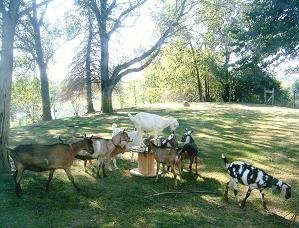
Being that we are in the middle of winter, I have caught myself flipping through my sunny weather pics of kids quite a bit recently. This one was taken in September. The doeling on the spool, a snubian, seems to have almost doubled in size. She caught my eye a few days ago, made me wonder who she was for a moment! I love the growth of a kid from a saanan dam and a nubian sire. The spotted doe to the right, Aleecia is also growing out to be a nice sized nubian doe, and one that is vocal to boot. 🙂
Posted in Goat Care (and General Farm), tagged Goats on December 25, 2008| 10 Comments »

I never grow tired of this scene. Right now, today I look out the office window and see a similar view (as the one from this summer photo). My girls are gathered around, soaking in some December sun. Some are chewing their cud, some just curled up for a nap, some are playfully butting heads. Most are motionless, obviously very relaxed. And I consider them beautiful.
What is it about a goat? Why do I feel compelled to allow the warm goat kisses on my nose each day? Why do I stand still hoping for the daily nibble on my nose, or the sniffing of my neck? Why do their friendly, inquisitive eyes draw me in?
We raise boer and dairy goats. Amongst the dairy, the nubians outrank by numbers. This admission can cause silent, and not so silent wars amongst “goat people,” but I’ll openly admit that my favorites are the nubian does, especially the nubian doelings.
I bottle raise every dairy kid born on our farm. My original dreams were to open a commercial dairy operation. I have not given up on that thought, however, for now, the Ohio red tape is daunting, and I am satisfied with using fresh milk in my soap, lotion, and cheese. I then have just enough milk for the dairy kids and the few boer kids that happen along and need human intervention. With all of this being said, dairy kids tend to adopt the human parent, the one that provides the feedings, especially the nubian kids. They can be quite noisey, with some of their “Mawwww” bellows, but I certainly do not mind. They are a special animal. Loyal as in pets (trailing behind like a loving dog), yet graceful and beautiful as in a deer, and silly as in no other species!
Am I in love? Yes! Am I blessed? Yes! Even in these challenging times, I find ways to make sure the goats stay. I try to take each one and hold them to a purpose. They have a job to do, each and every one of them, and for me the job extends out to a daily dose of caring for the animals that I love.
Posted in Goat Care (and General Farm), tagged Charity, Goats on December 21, 2008| 2 Comments »
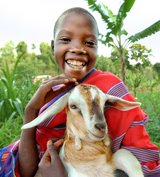
I am not going to directly quote any particular program, nor am I going to endorse a program, I have nothing to back me up. But I can tell you what I have picked up on in my readings.
Some of the charities will accept your donation for the purpose of providing a family with a goat. The program teaches the family, and especially the goat care giver (normally the mother of the family), how to care for a goat.
The dairy goat is milked, providing milk for the family, and excess milk generally is sold by the family, which is extra income. I drink goat milk myself. I stand behind the great wealth of its health benefits!
Goats are proliferous breeders, so one healthy goat can lead to 3 or 4, and more in a couple of years span, which also helps the families income. Buying that first goat is what they need help with, and the education of how to care for the goat.
In my own opinion, this is a wonderful way to help others, with a twist to it!
To keep myself out of hot water, the photo belongs to one particular charity, http://www.worldvision.org/ .
Posted in Goat Care (and General Farm), tagged Goats on December 20, 2008| 5 Comments »

Today I am writing this in very good spirits.
Just who is Annie?
It is not me. Annie is a boer goat.
Annie was our first bottle kid. She was given to us by a very good friend, who was already inundated with a house full of bottle kids.
It was a cold, damp, miserable morning and both of my friends needed to get to work. I received the phone call for help. Please come rescue this orphan, raise her on your farm. The question was worded, “Can you come and help? Helen (a school teacher) needs to go to work!”
Was I ever nervous! We brought her home with the bottle of frozen colostrum (I still have the tiny bottle). We made sure she was dry and comfortable, then we left to buy some kid supplies (nipples and milk replacer). We arrived back home to what we thought was a dead kid. Annie slowly opened her eyes, apparently from a good rest. We jumped for joy. Silly people, we were!
As Annie grew up, she loved to sit in my lap and chew her cud. She weighs in now at 150-170 pounds, too large to sit in my lap. And now she even has an attitude. But she is still our first bottle baby, and she will always be special. Special enough to be the farm mascot.
I didn’t note in yesterday’s blog, I will do an ingredient article weekly (at the minimum), hoping to write them more often!
Have a wonderful Saturday!

| What is Goat Polio?… on Thiamine Deficiency – Ca… | |
| Goat Illnesses and S… on Thiamine Deficiency – Ca… | |
 | Mary Humphrey on Selenium Deficiency In Go… |
 Annies Goat Hill Handcrafted Soaps